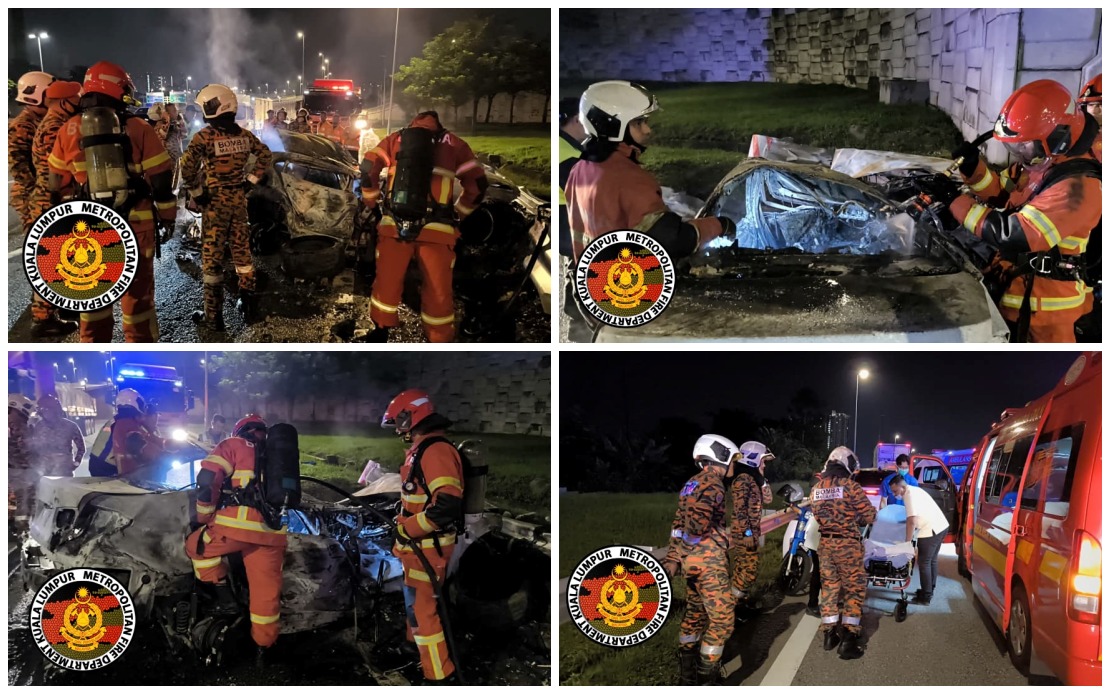
A tragic accident on Kuala Lumpur's busy Duta-Ulu Kelang Expressway has claimed the lives of two young Malaysian students, leaving their families devastated and raising fresh concerns about reckless driving on the capital's major thoroughfares. The incident unfolded in the early hours of Wednesday morning at the Jalan Kuching exit ramp, where a BMW 328i Sport veered catastrophically out of control, struck a concrete road divider, and became engulfed in flames within seconds. The impact was violent enough to render both victims unable to escape, trapping them inside the burning wreckage.
According to ACP Mohd Zamzuri Mohd Isa, chief of the Kuala Lumpur Traffic Investigation and Enforcement Department, the vehicle had been travelling from Jalan Duta towards Selayang when evidence suggests excessive speed precipitated the driver's loss of control. Once the BMW began to skid, the trajectory proved fatal—rather than slowing or recovering, the sedan struck the left-hand barrier with sufficient force to cause instantaneous ignition. Police believe the intensity of the post-collision fire, likely exacerbated by ruptured fuel lines and the vehicle's fuel tank, prevented any possibility of evacuation.
The two deceased passengers represent a cross-section of Malaysia's university community. The 22-year-old driver was enrolled at Queensland University of Technology in Australia, suggesting he may have been home for a break or completing an exchange arrangement. His 21-year-old companion, seated in the front passenger position, was a student at Sunway University, one of Malaysia's prominent private higher education institutions. Both men were confirmed dead at the scene, their bodies too severely burned for immediate visual identification. Authorities have announced that DNA analysis will be necessary to formally establish their identities—a process that underscores the intensity of the inferno.
A third occupant, a 20-year-old Singaporean male student, managed to escape with only minor injuries, a fortunate outcome that stands in stark contrast to the fate of his companions. This survivor's injuries required hospital attention at Kuala Lumpur Hospital, but his condition appeared stable enough that he could provide initial statements to investigators. His account of events—how the crash unfolded, the speed at which the vehicle was travelling, and any warnings or sensations experienced just before impact—has become crucial to police reconstructing the sequence of events.
The investigation now centres on establishing definitively whether speed was the primary factor in this tragedy. While preliminary findings suggest the BMW was being driven well above safe limits for that expressway section, forensic engineers will examine skid marks, impact patterns, and the vehicle's damaged components to calculate precise velocities. The expressway's closed-circuit television systems have been flagged for review, with footage potentially showing the moments leading up to the collision and providing objective documentation of the vehicle's trajectory and velocity.
This accident arrives amid ongoing public discourse about road safety in Malaysia's urban corridors. The Duta-Ulu Kelang Expressway is a critical artery connecting the northern suburbs to central Kuala Lumpur, carrying substantial traffic volumes, particularly during morning and evening commutes. Sections of the expressway, including the Jalan Kuching exit, have seen previous incidents, prompting occasional calls for enhanced enforcement and infrastructure modifications. The tragedy involving two young men, one of whom was likely visiting from Australia, adds an international dimension to the incident and may prompt diplomatic attention.
Malaysian authorities have proceeded with investigations under Section 41(1) of the Road Transport Act 1987, which governs dangerous driving causing death. This legal framework allows for serious charges to be pursued if negligence or recklessness can be substantiated. The surviving passenger will be pivotal to these proceedings, as his testimony regarding the vehicle's speed, any mechanical issues, weather conditions, or the driver's apparent state of alertness could significantly influence how charges are ultimately framed.
The incident highlights the vulnerability of young drivers navigating high-speed expressway environments, particularly during late-night or early-morning hours when fatigue may compound poor judgment. Queensland University of Technology and Sunway University have undoubtedly been contacted by Malaysian authorities, and both institutions will likely issue statements expressing condolences and support for affected families. For parents who sent their sons to pursue education in Malaysia or abroad, the shock of receiving such news via police notification represents an unimaginable loss.
Police have appealed to the public for any available dashcam footage or eyewitness accounts from the early morning period when the crash occurred. Such material could prove invaluable in determining whether other vehicles were involved, whether any warning signs preceded the collision, or whether other factors—such as sudden lane changes by nearby drivers—contributed to the sequence of events. Citizens with relevant information have been directed to contact the Traffic Police Station on Jalan Tun H.S. Lee or any nearby police station.
This tragedy underscores the enduring menace of speed-related accidents on Malaysian expressways, where the combination of modern vehicle performance, driver inexperience, and fatigue can prove instantly lethal. The incident will likely fuel renewed discussions about speed enforcement cameras, mandatory advanced driver training for young motorists, and whether additional safety barriers should be installed at high-risk locations. For the families of the two deceased students, and for the survivor processing his narrow escape, the coming months will demand resilience amid profound grief.

