A dramatic early-morning fire at Block 842 Jurong West Street 81 forced the Singapore Civil Defence Force into a swift rescue operation on June 17, pulling two people from a 13th-storey unit engulfed in smoke and flames. The incident underscores the persistent risk of residential fires across Singapore's public housing estates and the critical importance of vigilant neighbours in high-rise living environments, where swift action can mean the difference between life-altering injury and safe evacuation.
The SCDF received an emergency call at approximately 3.35am, dispatching crews to find the living room of the affected unit fully ablaze. Firefighters navigated through thick, acrid smoke to reach the trapped residents, bringing the fire under control using water jets. Beyond the two people extracted from the unit, all four family members were transported to Singapore General Hospital for medical evaluation and treatment. The rapid response likely prevented a far more catastrophic outcome, though the burns suffered by at least two residents suggest the intensity of the blaze.
Neighbourly alertness played a crucial role in activating the emergency response chain. An 18-year-old student living directly above the affected unit, who happened to be awake gaming, detected smoke billowing from the windows below and immediately grasped the danger. Rather than assuming someone else would respond, he took decisive action—knocking loudly on neighbouring doors to wake residents and urge evacuation, then sprinting home to alert his own family. His mother then telephoned police and the SCDF, initiating the official emergency response. This sequence of events illustrates how apartment-dwellers in multi-storey blocks depend on each other in ways that transcend the usual civilities of urban living.
The student's account of events captures the chaos and physical trauma of a sudden residential fire. He recalled encountering a young woman from the burning unit at his family's door, her hair singed and face blackened with soot, seeking towels to treat her father's injuries. He also witnessed a man with extensive burns across his back and arms—vivid testimony to the ferocity of electrical fires confined within residential spaces. These details humanise what might otherwise be an abstract incident report and highlight the serious medical consequences residents faced.
Preliminary investigation by the SCDF points to an electrical origin in the living room as the likely cause. This conclusion carries significant weight given Singapore's regulatory environment, suggesting that even certified electrical installations can pose risks if overloaded or if devices are not properly maintained. The family had been asleep when the fire ignited, rendering them particularly vulnerable to smoke inhalation and the rapid spread of flames—a scenario that plays out with disturbing frequency in residential fires across the region.
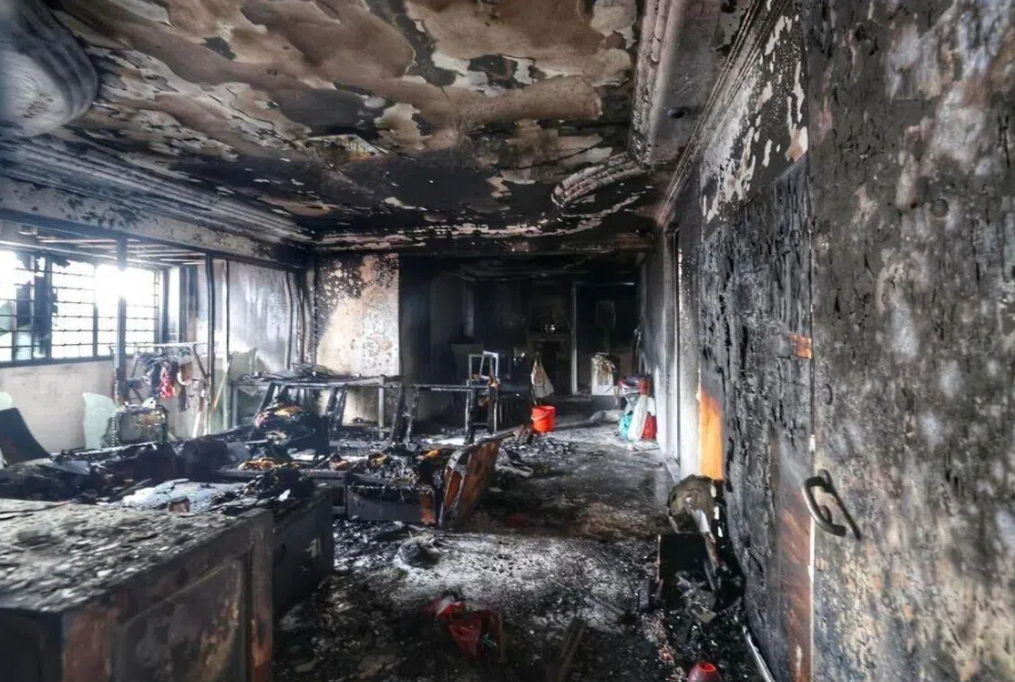
About 40 residents from neighbouring units were evacuated as a precautionary measure, a necessary inconvenience that prevented the fire from potentially spreading to adjacent flats. Photographs taken by reporters from Lianhe Zaobao at the scene several hours later revealed the extent of the damage: blackened walls and ceilings, shattered windows, and a gutted interior testifying to the intense heat generated within that confined space. Such visible destruction serves as a sobering reminder of what can unfold in minutes when electrical systems fail catastrophically.
The incident arrives amid a concerning upward trend in Singapore's residential fire statistics. According to SCDF's annual data released in February, the total number of fires climbed three percent year-on-year, rising from 1,990 incidents in 2024 to 2,050 in 2025. More troubling still, residential buildings accounted for just over half of all fires—1,051 cases—indicating that homes remain the highest-risk category. This trajectory suggests that existing fire safety measures are struggling to keep pace with underlying hazards in the housing stock.
In response to such incidents, the SCDF has intensified public messaging around electrical fire prevention. The agency advises residents to avoid overloading power outlets, a practice that remains surprisingly common in households across Southeast Asia where multiple appliances compete for limited access points. Switching off devices when not in use represents basic but often-neglected practice. The SCDF particularly emphasises the importance of using only appliances and electrical cords bearing the Safety Mark, a certification issued by Singapore's Consumer Product Safety Office—a standard that should theoretically be universal but which counterfeit or substandard products can circumvent.
Charging practices warrant special attention in modern households. The SCDF explicitly warns against leaving batteries and devices to charge unattended overnight or for extended periods, guidance that carries particular relevance as mobile phones, power banks, and other lithium-ion battery devices have proliferated. These batteries can experience thermal runaway—a catastrophic failure mode—under certain conditions, generating sufficient heat to ignite nearby flammable materials. Yet many households routinely leave devices charging overnight, a convenience that can prove deadly.
For Malaysian readers, the Jurong West incident offers relevant lessons. While Malaysia's residential building codes and fire safety standards differ from Singapore's, electrical fires remain a leading cause of residential property damage and injury across the region. The underlying hazards—overloaded circuits, aging wiring, and unattended charging—transcend national boundaries. Malaysian apartment dwellers in similar multi-storey environments face comparable risks, and the proactive response by the student neighbour demonstrates how community vigilance functions as an essential safety layer that regulations alone cannot provide.
The incident also raises questions about the adequacy of fire safety education and awareness campaigns. Despite regular SCDF advisories and public health messaging, Singaporeans continue to experience rising residential fire incidence, suggesting that knowledge transfer is not automatically converting into behavioural change. This gap between information and practice represents a persistent challenge across Southeast Asia, where cultural attitudes toward risk, convenience, and preventive action may not align with official safety recommendations.
Looking forward, the Jurong West fire will likely prompt renewed scrutiny of electrical safety in HDB estates. Building management authorities and residents alike must recognise that prevention requires constant vigilance—inspecting outlets and cords for signs of damage, resisting the temptation to daisy-chain power strips, and integrating fire safety into the routines of daily life rather than treating it as an abstract regulatory concern. The fortunate outcome in this instance, where no lives were lost despite serious injuries, should not breed complacency. The next fire may not end so favourably.