Hanoi police have brought smuggling charges against two businesswomen following an investigation that uncovered an elaborate scheme to circumvent Vietnam's food safety regulations through the illegal domestic distribution of frozen chicken feet. The case exposes significant vulnerabilities in Vietnam's customs oversight and cold-chain logistics networks, raising concerns that could ripple across Southeast Asia's trade corridors.
Nguyen Thi To Loan, 47, who operated ABF Food Import-Export JSC in Ninh Binh Province, and Trang Tuyet Ngoc, 45, an official with An Binh Group, have both admitted to all charges filed by Hanoi authorities. The investigation reveals that between 2023 and 2026, the two women orchestrated the importation of 339 shipping containers of frozen poultry feet originating from countries designated as having active poultry disease outbreaks. According to customs documentation fraudulently filed with Vietnamese authorities, these shipments were classified solely as temporary imports destined for industrial processing and subsequent re-export, a legal mechanism designed specifically to prevent disease contamination of domestic food supplies.
Under Vietnamese law, frozen poultry products from disease-endemic regions face strict import prohibitions for domestic consumption. The regulatory framework permits their entry only when they are explicitly intended for manufacturing value-added products for export markets, a controlled pathway that theoretically prevents contaminated products from entering the local food supply chain. Loan and Ngoc systematically violated this safeguard by diverting imported chicken feet directly into Vietnam's domestic market instead of completing re-export protocols.
The operational scope of the conspiracy was substantial. Over a three-year period, the pair distributed more than 10,000 metric tonnes of frozen chicken feet to food-service establishments across multiple provinces including Hanoi, Cao Bang, Ninh Binh, and Quang Ninh. The total declared import value exceeded VNĐ347 billion, equivalent to approximately US$13 million, yet authorities found no evidence that customs duties had been paid on these shipments. The financial evasion component of the scheme underscores a dual fraud—both health-safety violations and tax avoidance.
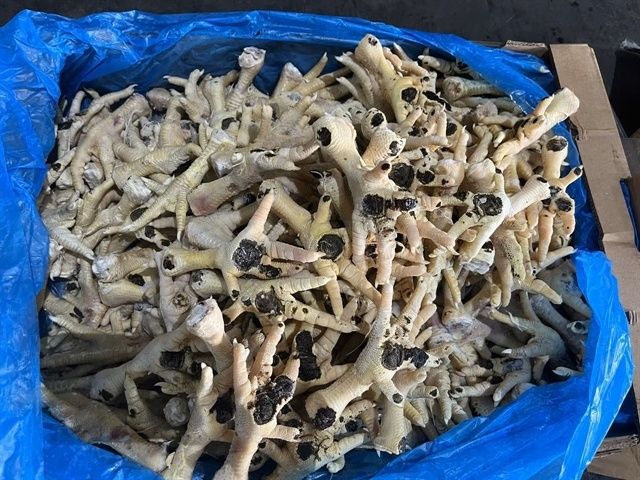
Police raids on storage facilities connected to the operation uncovered the physical scale of accumulated inventory. At the An Viet 2 freezer warehouse located in Hanoi's Quang Minh Industrial Zone, investigators discovered more than 1,000 metric tonnes of frozen chicken feet, including approximately 260 metric tonnes that had exceeded shelf life and displayed visible contamination—mold growth and offensive odours indicating decomposition—yet appeared to be readied for further distribution. An additional search at the THL cold-storage facility in Lang Son Province yielded over 1,030 metric tonnes of product, suggesting a sophisticated distribution network with multiple storage hubs.
The discovery of expired and visibly contaminated poultry products positioned for sale is particularly alarming from a public health perspective. Mold-contaminated chicken feet pose serious foodborne illness risks, potentially carrying mycotoxins and pathogenic microorganisms. That such degraded inventory was staged for continued distribution indicates the perpetrators prioritised financial recovery over consumer safety, a calculation that suggests either reckless indifference or deliberate disregard for health consequences.
The charges filed under Article 188 of Vietnam's 2015 Penal Code carry potentially severe penalties reflecting the seriousness of organised food fraud. Yet the investigation remains incomplete. Hanoi police have acknowledged that determining the full extent of the conspiracy requires identifying other individuals and organisations embedded within the smuggling network. The involvement of An Binh Group, a larger corporate entity, suggests this may have extended beyond two individual actors to encompass a broader distribution and logistics infrastructure.
For Malaysian readers and Southeast Asian traders, this case illuminates persistent food-safety risks within regional supply chains. Vietnam's food-processing and export sectors play crucial roles in regional trade, and vulnerabilities in Vietnamese import controls have potential spillover effects. If tainted products sourced from disease-endemic regions entered Vietnamese processing chains, downstream export products destined for neighbouring countries could carry hidden contamination risks. Malaysian importers of processed poultry products from Vietnam face indirect exposure to these regulatory failures.
The scheme's mechanics also reveal how formal customs documentation can be weaponised through fraudulent classification. When shipments are declared for re-export but diverted domestically, enforcement depends on post-import monitoring and warehouse inspections—precisely the areas where resource constraints and corruption create enforcement gaps. The successful operation of this network for three years suggests systematic oversight failures or possible collusion with port and warehouse officials.
Beyond food safety, the case highlights the vulnerability of Southeast Asian borders to organised commodity smuggling. Chicken feet represent relatively modest-value products individually, yet bulk exports qualify as significant trade goods; the ability to move 339 containers across state lines indicates logistical sophistication and possibly corruption within customs administration. Similar schemes could target higher-value commodities across the region.
The investigation's ongoing phase will reveal whether this operation functioned as an isolated incident or represented one component of a larger criminal enterprise. Involvement of multiple warehouses, provinces, and commercial entities suggests structural coordination. If organised crime networks have identified food smuggling as a reliable revenue source within Vietnam's regulatory environment, authorities across Southeast Asia should anticipate similar schemes targeting their own markets.
Vietnam's response demonstrates commitment to prosecuting food-fraud cases, yet the fact that such a large-scale operation persisted for three years before detection raises questions about preventive controls. For Malaysia and other nations importing Vietnamese food products, the case underscores the necessity for independent verification protocols and enhanced import screening, particularly for items sourced from nations with disease outbreaks.

