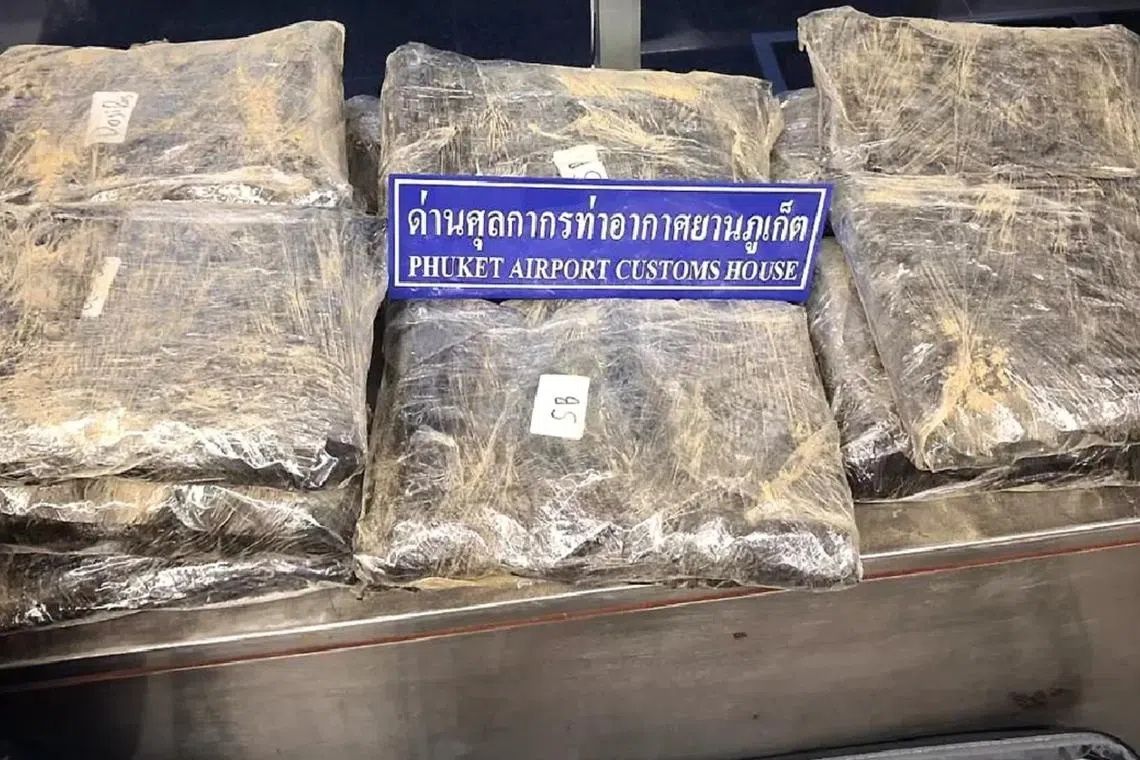
Thai and Filipino nationals were taken into custody at Phuket International Airport on Thursday after customs officers uncovered a significant cannabis shipment concealed in their checked baggage. The discovery of more than 32 kilograms of cannabis flowers marks another notable interdiction in Thailand's ongoing campaign against narcotics smuggling through its major transport hubs. The operation, conducted jointly by Phuket Airport Customs House and Sakhu Police Station personnel within the international departures terminal, resulted in charges against both women under multiple legislative frameworks governing customs violations and controlled substances.
The first detainee was 18-year-old Filipino national Levannah Chelsea Guzman, apprehended during a routine luggage inspection at approximately 11 in the morning. Officers examining her black Pierre Cardin wheeled suitcase discovered 14 vacuum-sealed packages containing processed cannabis flowers. The contraband, together with its packaging materials, totalled 14.5 kilograms. Upon interrogation, Guzman did not dispute ownership of the luggage or its contents, according to statements released by authorities following the arrest.
The second apprehension occurred roughly two hours later when inspectors grew suspicious of a green Swish Navy wheeled suitcase registered to Thai national Penpitcha Phutsiang. A more thorough examination revealed 16 similarly packaged units of cannabis flowers with a combined mass of 17.6 kilograms. Like her counterpart, Phutsiang acknowledged that both the suitcase and all confiscated materials belonged to her. Both individuals were subsequently transferred to Sakhu Police Station where they faced formal investigation and judicial proceedings.
Both women faced prosecution under Thailand's Customs Act BE 2560 (2017), specifically the provision addressing the unauthorised exportation of goods lacking proper customs clearance. Beyond customs violations, they were also charged according to the country's Narcotics Code, establishing a clear violation of national drug control statutes. Additional charges were brought under the Protection and Promotion of Traditional Thai Medicine Wisdom Act BE 2542 (1999), reflecting Thailand's complex regulatory approach to cannabis, which has evolved significantly in recent years as authorities have attempted to distinguish between traditional medicinal applications and illicit recreational trade.
The prosecution further included offences under the Public Health Ministry's 2025 notification concerning controlled herbs and cannabis, demonstrating the ongoing refinement of Thailand's regulatory framework around cannabis products. This layered approach to charges suggests prosecutors intend to establish the most comprehensive case possible, with each statute addressing different dimensions of the alleged violation. The multiplicity of charges also underscores how Thai authorities treat airport smuggling operations as serious organised activities rather than isolated incidents.
The timing of these arrests reflects heightened vigilance at Thailand's international gateways. Airports have become focal points for interdiction efforts, as smugglers frequently attempt to exploit busy terminal environments where large volumes of passengers and baggage facilitate concealment. The identical vacuum-sealing methodology employed in both suitcases suggests potential coordination between the detainees, though authorities have not publicly confirmed whether they were travelling together or had prior knowledge of each other's intentions.
For regional observers, the Phuket airport seizure illustrates the persistent challenge Southeast Asian nations face in combating cannabis trafficking. Despite stricter regulations and enforcement protocols, the volume and frequency of interceptions indicate that markets for cannabis products remain substantial, particularly given Thailand's established position as a transit point for goods destined for international distribution. The recovery of 32 kilograms in a single day operation suggests that even larger quantities likely evade detection across the region's airports daily.
The operation also highlights the complex regulatory environment surrounding cannabis in Thailand. While the country has permitted certain medicinal and traditional applications of cannabis products through licensing and controlled cultivation arrangements, the distinction between legal and illegal supply chains remains extremely narrow. Any attempt to export cannabis products without explicit authorisation, regardless of intended purpose, constitutes a serious criminal violation. This stringent approach reflects Thailand's commitment to maintaining international cooperation on narcotics control despite its more lenient domestic stance toward medical cannabis.
For Malaysian and regional travellers, the Phuket arrests serve as a cautionary reminder about the severe consequences of attempting to transport cannabis across international boundaries. Even small quantities can result in lengthy prison sentences and substantial fines throughout Southeast Asia. Thai courts have historically imposed substantial penalties for such offences, with sentences often extending to several years of imprisonment. The fact that both detainees were young individuals—one not yet an adult—illustrates how smuggling operations sometimes recruit less experienced persons, often unaware of the severe legal consequences they face.
Customs authorities across the region have responded to increased smuggling attempts by deploying advanced scanning technologies and training personnel in identifying concealment methods. The vacuum-sealed packaging technique discovered in the Phuket case remains common among smugglers attempting to mask the odour of cannabis products from detection dogs. However, modern X-ray and physical inspection protocols have become increasingly effective at identifying such concealment methods, making airport-based trafficking substantially riskier than alternative smuggling routes.
The broader context of these arrests involves Thailand's complex relationship with cannabis regulation. Since decriminalising hemp cultivation and permitting limited medicinal applications, the country has attempted to establish legal frameworks distinguishing between authorised domestic production and illicit international trafficking. This regulatory middle ground creates enforcement challenges, as authorities must determine whether seized materials fall within permitted categories or constitute criminal contraband. The stringency applied to these Phuket cases suggests officials maintain zero tolerance for unauthorised export attempts regardless of potential medicinal applications.
Stakeholders across Southeast Asia, including Malaysian customs and law enforcement agencies, monitor Thailand's enforcement approaches closely as they inform regional best practices. Intelligence sharing between ASEAN nations regarding smuggling patterns, trafficking methodology, and suspect networks has improved significantly over recent years. The consistency of enforcement demonstrated at Phuket International Airport reflects these collaborative efforts and commitment to maintaining secure international travel corridors throughout the region.

