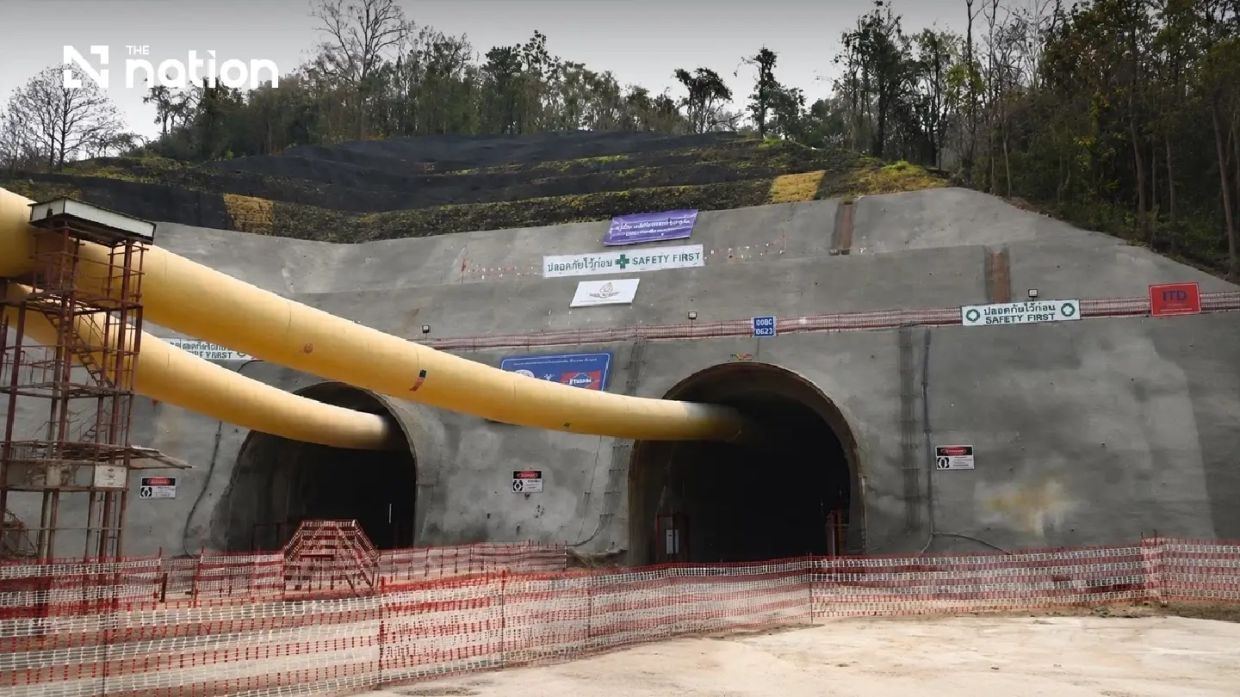
Two workers have died and seven others sustained injuries after a scaffolding structure gave way inside the Doi Luang railway tunnel in Chiang Rai on Saturday evening. The incident took place during ongoing construction work on the State Railway of Thailand's ambitious Den Chai-Chiang Rai-Chiang Khong railway line, a multi-billion-baht project aimed at improving regional connectivity across northern Thailand and into Laos. Emergency responders received notification of the accident at 8.35pm, triggering immediate rescue and medical response operations.
According to Deputy Transport Minister Siripong Angkasakulkiat, preliminary investigations point to rockfall from the tunnel's interior walls as the likely trigger for the structural failure. Workers were engaged in installing a waterproofing system when rocks dislodged from above and brought down the scaffolding framework supporting their operations. Earlier accounts had mentioned complications in the shotcrete—sprayed concrete—work area, but investigators are still piecing together the precise sequence of events that led to the collapse. The complexity of working inside a deep tunnel with active rock faces creates multiple hazard scenarios that require thorough forensic analysis.
The immediate toll of the disaster reflects the occupational risks inherent in large-scale underground infrastructure projects. Of the nine workers affected, three sustained serious injuries while four experienced minor harm. All casualties were transported to medical facilities for treatment and observation. The Deputy Transport Minister confirmed that the accident site has been cordoned off and secured to prevent further incidents, with the project's safety management team now maintaining strict control of the area pending the completion of detailed investigations.
The Doi Luang tunnel represents a critical structural element within the larger railway development. Stretching 3.4 kilometres beneath the Chiang Saen district, the tunnel has already been fully bored through the mountain, leaving the internal finishing and systems installation phase—the stage during which this tragedy occurred. This segment of work requires meticulous attention to safety protocols, as workers operate in confined spaces where visibility is limited and emergency egress routes may be restricted.
The tunnel is situated within Contract 3 of the Chiang Rai-Chiang Khong section, a contract valued at 19.385 billion baht. This particular work package encompasses far more than the tunnel itself; it involves laying at-grade and elevated railway tracks across approximately 87 kilometres, constructing three full stations and three railway halts, installing signalling and telecommunications systems, and completing all ancillary infrastructure necessary for operational railway service. The scope illustrates why safety management is paramount—a single accident can disrupt an entire project timeline and expose systemic vulnerabilities across multiple work fronts.
The construction consortium managing this section, known as CKST-DC3 Joint Venture, comprises three entities: CH. Karnchang Public Company Limited, Sino-Thai Engineering & Construction Public Company Limited, and Chiangmai Construction Co., Ltd. This tripartite arrangement reflects the scale and complexity of the undertaking, requiring the combined expertise and resources of major regional construction firms. The joint venture structure, while distributing risk and capability, also creates responsibility chains that investigators will need to examine when determining accountability for safety failures.
The Den Chai-Chiang Rai-Chiang Khong railway line represents a strategic infrastructure investment for Thailand, designed to facilitate freight and passenger movement through the northern region and establish direct rail connectivity toward Laos. The project's importance makes safety lapses particularly consequential, as they can trigger cost overruns, schedule delays, and erosion of public and investor confidence in major transportation initiatives. For Malaysia and other Southeast Asian nations pursuing similar railway expansion programmes, this incident underscores the critical importance of rigorous site supervision, worker training, and adherence to international construction safety standards.
The investigation process now underway will examine whether the rockfall was a predictable geological hazard that should have triggered different work methodology, or whether it represents an anomalous event despite proper precautions. Engineers will scrutinise whether the scaffolding system was adequately engineered for the specific conditions of the Doi Luang tunnel, including any unforeseen geological characteristics revealed during boring operations. The state railway authority and the transport ministry have committed to transparency in reporting findings as the investigation progresses.
This tragedy arrives amid ongoing regional development of rail infrastructure across Southeast Asia, with multiple countries undertaking ambitious tunnel and bridge projects. The incident serves as a sobering reminder that even with modern engineering knowledge and equipment, underground construction remains inherently hazardous work. Worker safety protocols, site management vigilance, and rapid incident response all become critical differentiators between facilities where accidents remain rare and those where safety culture deteriorates.
The transport ministry indicated that further updates would be provided once investigations yield comprehensive findings. In the interim, the State Railway of Thailand's Special Projects and Construction Department has moved to inspect the accident site directly, ensuring that senior officials have first-hand understanding of the conditions and circumstances surrounding the collapse. This hands-on oversight approach may help prevent similar incidents elsewhere within the railway project portfolio and contribute to refinement of safety procedures across Thailand's expanding rail construction activities.

