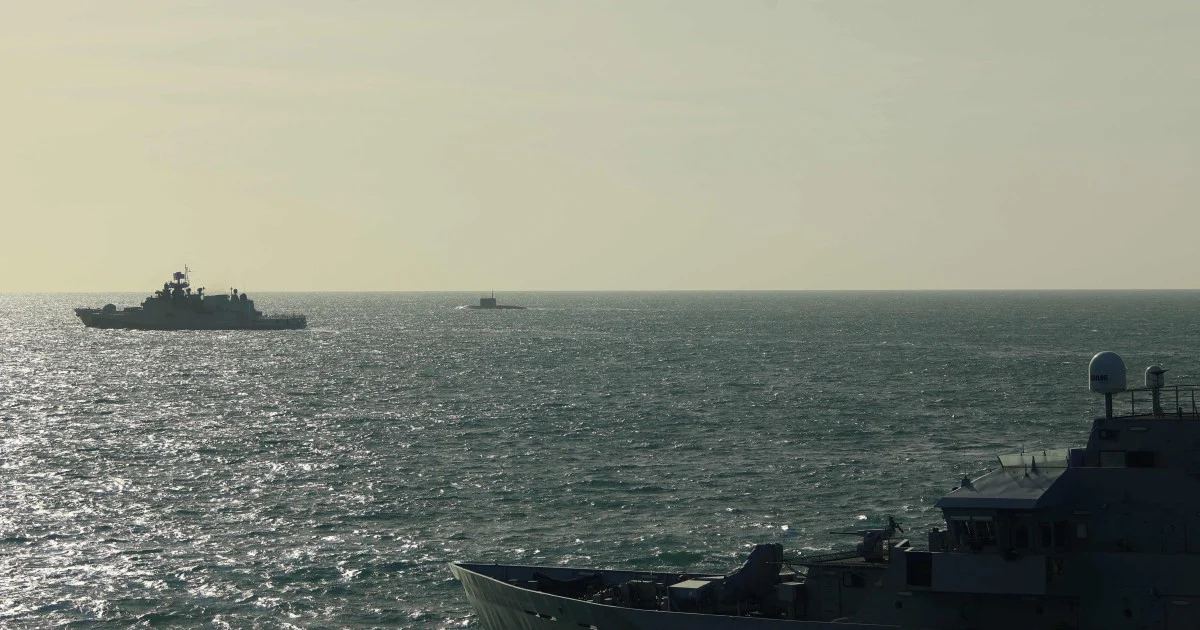
UK Prime Minister Keir Starmer has sought to characterise a recent incident involving a Russian warship in the English Channel as reckless behaviour rather than calculated provocation, drawing a distinction that speaks to the complexity of interpreting military actions at sea during a period of heightened geopolitical tension. Speaking on Wednesday, Starmer stopped short of describing the firing of warning shots near a privately registered yacht as a sinister act, instead emphasising the dangerousness of the conduct without suggesting it represented Moscow's deliberate escalation strategy.
The incident, occurring in one of the world's busiest shipping lanes connecting continental Europe to the North Sea and Atlantic, highlights the precarious situation developing between Russian and British naval forces in waters claimed by the United Kingdom as territorial space. The English Channel serves as a critical maritime corridor for international commerce and naval operations, making any military action there a matter of significant concern for regional security and the free passage of shipping. The proximity of the incident to British territory and major civilian maritime traffic underscores why such events attract immediate political attention in London.
Starmer's careful language—distinguishing between reckless and sinister—reflects the delicate diplomatic position the UK government must navigate when responding to Russian military activity. By avoiding the term "sinister," which would imply deliberate hostile intent and calculated provocation, the Prime Minister keeps space for diplomatic communication while still condemning the action itself. This rhetorical approach allows the government to register strong disapproval without triggering an escalatory spiral or precluding future dialogue with Moscow, a balance that has become increasingly important as military incidents accumulate across multiple zones of contact between NATO and Russian forces.
The characterisation of the action as "reckless" carries significant weight in its own right, suggesting that regardless of Moscow's intentions, the firing of warning shots near civilian or commercial vessels represents dangerous and irresponsible behaviour that threatens lives and undermines maritime safety protocols. Recklessness implies a disregard for consequences and a failure to exercise proper caution in operations at sea, particularly in contested waters where numerous vessels from different nations navigate simultaneously. This framing allows Starmer to defend British interests and express concern without necessarily implying that Russia deliberately sought military escalation.
The incident occurs within a broader context of intensifying military interactions between NATO powers and Russia around maritime borders and disputed zones. The English Channel and surrounding waters have become flashpoints for naval posturing, with Russian vessels regularly transiting through waters Britain regards as its territorial sphere. The increasing frequency of such encounters reflects deepening strategic competition and the absence of reliable de-escalation mechanisms that might prevent dangerous situations from developing. For maritime nations across Europe and beyond, including those in Southeast Asia dependent on stable international shipping lanes, such incidents raise concerns about the rules governing naval conduct and the maintenance of freedom of navigation.
The timing of Starmer's comments underscores how political leaders must respond immediately to military incidents that capture public attention and raise broader security concerns. The UK government faces pressure from Parliament, the media, and public opinion to demonstrate resolve in defending national interests while avoiding rhetorical moves that could provoke further Russian action. The Prime Minister's statement represents an attempt to thread this needle, appearing firm without appearing trigger-happy, and maintaining British dignity while acknowledging that Moscow's actions, whatever their motivation, constitute unacceptable conduct in international waters.
For Malaysia and other Southeast Asian nations, particularly those with interests in maritime security and stable international order, the UK-Russia tensions serve as a reminder of how great power competition can manifest through military actions at sea. The principles governing freedom of navigation and peaceful passage through international waters, which Malaysia and its regional partners depend upon for their own security and economic prosperity, become uncertain when powerful nations engage in confrontational maritime behaviour. The incident also illustrates how naval incidents can rapidly escalate without clear communication protocols, a concern that resonates throughout Southeast Asia where multiple nations maintain overlapping maritime interests.
The underlying causes of the incident—whether Russian vessels are conducting routine operations that happen to involve warning shots, or whether Moscow is deliberately testing Western resolve—remain contested. Starmer's distinction between recklessness and sinister intent captures this ambiguity, acknowledging that even without assuming the worst about Russian intentions, the behaviour itself warrants criticism. This interpretive approach leaves room for the possibility that the incident resulted from operational procedures or miscommunication rather than strategic planning, though it does not excuse the actual conduct.
Looking forward, the UK government will likely face continued pressure to articulate clear red lines regarding Russian military activity in British waters while maintaining the distinction between dangerous behaviour and deliberate hostility. The challenge for London involves deterring further incidents through credible responses without triggering a security spiral that might prove difficult to control. Similarly, for Moscow, the incident demonstrates both the opportunities and risks of asserting itself in Western-dominated maritime spaces during a period of strategic competition.
The English Channel incident ultimately reflects the fragile state of UK-Russia relations and the absence of stabilising mechanisms that might prevent military interactions from becoming crises. Starmer's careful language suggests the government recognises that overreaction could prove counterproductive, even as it refuses to normalise such behaviour. As military incidents continue to punctuate the relationship between Britain and Russia, the ability to interpret such events accurately and respond proportionately will become increasingly important for preventing miscalculation at sea.