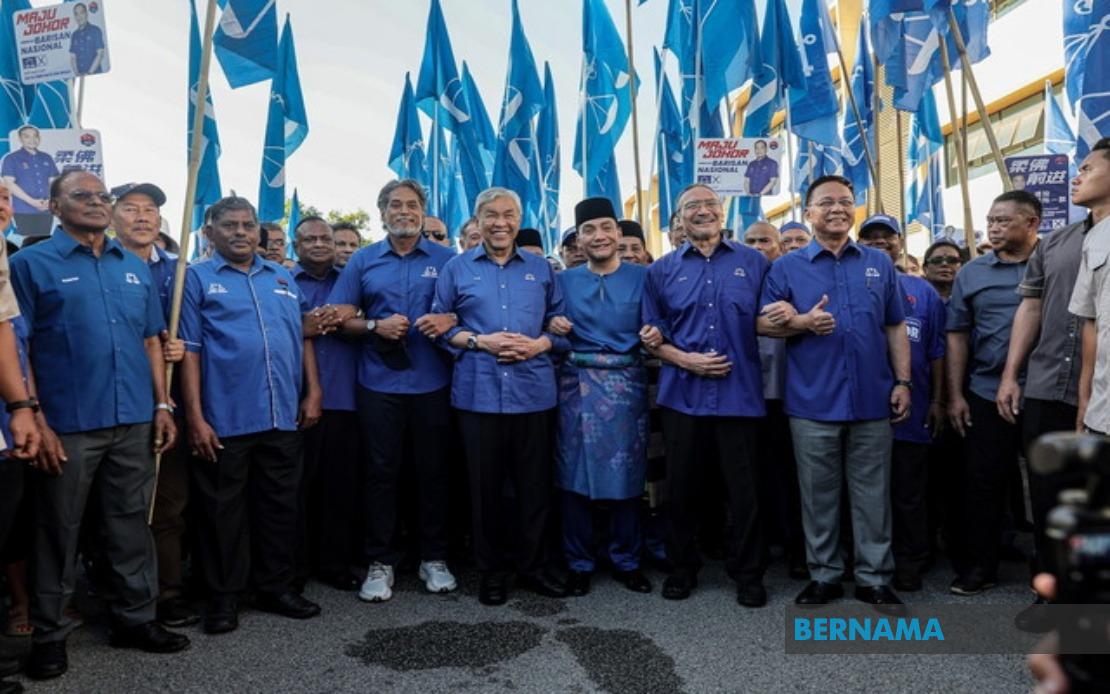
The Johor Barisan Nasional machinery demonstrated its organizational might on June 27 when chairman Datuk Onn Hafiz Ghazi filed his nomination papers at the Muafakat Hall in Simpang Renggam District Council at 9.10 am, flanked by the party's most prominent national figures. The incumbent Machap assemblyman's submission came as a show of strength from the ruling coalition, with UMNO president Datuk Seri Dr Ahmad Zahid Hamidi, Sembrong Member of Parliament Datuk Seri Hishammuddin Tun Hussein, and former minister Khairy Jamaluddin all present to demonstrate their support.
The presence of these heavyweight figures at the nomination centre carried significant political symbolism in Malaysian politics. Ahmad Zahid Hamidi's personal attendance underscored UMNO's commitment to retaining Johor, the federation's most influential and resource-rich state. Hishammuddin, who represents the neighbouring Sembrong constituency in federal parliament, provided an additional layer of cross-assembly solidarity, while Khairy's participation signalled intergenerational backing within the party establishment. Such coordinated appearances by senior party leadership are carefully orchestrated messages to both party members and the voting public about the organization's confidence and unity.
Onn Hafiz's position as Johor BN chairman carries considerable weight in the state's political ecosystem. As the outgoing Machap assemblyman, he was seeking renewed endorsement to represent his constituency in the Johor state assembly, a seat he currently holds within the BN framework. The nomination process itself represents a formal commitment to contesting in the coming polls, and the ceremonial nature of the event—with multiple national party leaders making the journey to the Simpang Renggam nomination centre—transformed what could have been a routine administrative filing into a high-profile media event and demonstration of party discipline.
The composition of the delegation reveals the intricate power dynamics within UMNO's upper echelons heading into the Johor election. Ahmad Zahid Hamidi's position as party president places him at the apex of UMNO's organizational structure, making his appearance a validation of Onn Hafiz's candidacy at the highest level. Hishammuddin's involvement bridges federal and state politics, while Khairy represents a younger generation of UMNO leaders increasingly prominent in the party's strategic decision-making. The former Johor Menteri Besar Datuk Seri Hasni Mohammad's attendance added local gravitas and continuity, connecting contemporary BN efforts with the state's political history under previous BN administrations.
The atmosphere at the nomination centre reflected the broader tenor of Johor's electoral campaign. Supporters gathered in the surrounding areas dressed in party colours and displaying banners and flags, creating the visual pageantry that characterizes Malaysian state election campaigns. These scenes of partisan mobilization provide both genuine grassroots enthusiasm and carefully managed optics, with party machinery ensuring adequate turnout to project momentum and organizational capacity to observers and media.
Johor's status as a crucial political battleground makes the state election far more than a regional matter. The federation's southern state serves as the economic powerhouse within Peninsular Malaysia and holds strategic importance in national coalition politics. A strong BN showing in Johor bolsters the coalition's credibility nationwide, while any erosion of BN support in the state would send tremors through federal-level politics. This dynamic explains the national-level engagement evident in the nomination filing, where top UMNO figures made themselves personally available to campaign for a state assembly seat.
The nomination submission process represents the formal inauguration of the electoral campaign phase. Once candidates file their papers, the machinery of party organizations shifts into higher gear, with ground operations becoming more visible and intensified. The presence of multiple national leaders at a single nomination filing suggests coordinated, top-down campaign strategy rather than grassroots spontaneity. Such orchestration reflects professional political management and the premium placed by UMNO on controlling messaging and maintaining party unity during elections.
For Malaysian political observers, the convergence of these particular figures at Onn Hafiz's nomination filing serves as a barometer of internal party relationships and factional alignments. In UMNO's complex power structure, public displays of unity—particularly involving figures who have occasionally competed for influence—carry substantial weight. The collaborative appearance indicated either genuine consensus within UMNO's leadership or at minimum a willingness to present unified faces to constituents and the broader public during the critical pre-election phase.
The broader implications for Johor's voters and Malaysian politics extend beyond the ceremonial aspects of nomination day. The state election will test BN's ability to retain control against opposition forces while navigating evolving voter preferences and socioeconomic challenges. The engagement of national-level UMNO leadership suggests the party views Johor as sufficiently competitive to warrant top-tier attention and resources. This investment of senior party figures' time and political capital reflects both confidence in BN's prospects and underlying anxiety about complacency or potential setbacks.
The systematic deployment of party hierarchy to support individual candidate nominations has become standard practice in Malaysian electoral politics, serving multiple functions simultaneously. It generates media coverage that benefits the candidate, demonstrates to party members that high-level support exists, reassures business and community interests that party resources will flow toward competitive constituencies, and creates visual narratives of party strength and organization. Onn Hafiz's nomination filing, elevated by the participation of Ahmad Zahid Hamidi and his colleagues, exemplified how Malaysian political parties convert routine procedural exercises into strategic communications opportunities.
As the 16th Johor state election proceeds through its nomination and campaign phases, the patterns established during nomination day—including the careful orchestration of senior leadership appearances—will likely persist. The participation of national UMNO figures in supporting state-level candidates reflects the interconnected nature of federal and state politics in Malaysia's system, where state assembly constituencies contribute to national political calculations and where party unity remains essential for electoral success.

