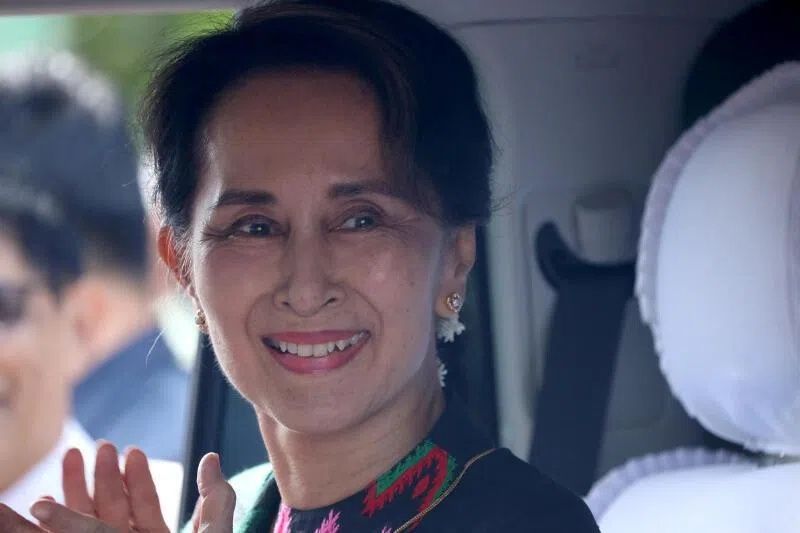
The United Nations' top envoy to Myanmar has made a fresh diplomatic appeal for the liberation of Aung San Suu Kyi, the nation's most prominent political prisoner, as the democracy icon observed her 81st birthday while under guard within the junta-controlled country. Julie Bishop, serving as UN special envoy, issued the statement before member states on Friday, June 19, pressing for immediate action to free the once-elected leader whose detention has become a symbol of the military's grip on power since the February 2021 coup.
Bishop's intervention came mere weeks after her fourth visit to Myanmar's capital, where she has consistently raised the case of Suu Kyi with the military administration in Naypyidaw. The envoy framed the situation as a fundamental obstacle to national reconciliation, arguing that meaningful progress toward peace remains impossible whilst the former State Counsellor languishes in custody. Her remarks underscore the persistence of international pressure on the junta, even as global attention to Myanmar's crisis has somewhat diminished in recent months.
The democracy leader's path to detention traces back to November 2020, when her National League for Democracy party achieved a decisive election victory, securing her position as State Counsellor under the nation's complex constitutional arrangement. However, the military's seizure of power just months later erased these democratic gains. The junta subsequently mounted a series of legal proceedings against Suu Kyi, resulting in convictions that have reportedly added up to more than thirty years of imprisonment, a sentence that appears deliberately constructed to prevent her release during her remaining lifetime.
In a move interpreted by observers as a potential softening of the hardest detention conditions, Myanmar's military leader Min Aung Hlaing announced in April that Suu Kyi would transition from incarceration to house arrest. This change suggested possible recognition of the international outcry surrounding her plight and the diplomatic costs of holding her in conventional prison facilities. Yet the announcement raised as many questions as it answered, leaving her precise circumstances shrouded in uncertainty. The regime has maintained strict information controls around her situation, preventing independent verification of her wellbeing.
The opacity surrounding Suu Kyi's current status has deeply alarmed her family. Her son, Kim Aris, has publicly demanded that Myanmar's ruling military junta furnish concrete proof that his mother remains alive and in reasonable health. This extraordinary appeal reflects the family's concerns about the reliability of any information the regime provides and highlights the breakdown in trust between the junta and both the international community and Suu Kyi's loved ones. Such demands from immediate family members carry particular weight in diplomatic contexts, as they signal genuine worry rather than purely political positioning.
The case of Aung San Suu Kyi holds deep resonance across Southeast Asia, where it represents a cautionary tale about the fragility of democratic institutions and the capacity of military forces to overturn electoral results. Malaysia, as a regional neighbour with its own complex history of civil-military relations and periodic political upheaval, observes the Myanmar situation with considerable interest. The prolonged detention of a Nobel Peace Prize recipient under what the international community widely views as spurious legal charges tests the international system's commitment to defending democratic values and human rights.
Bishop's repeated interventions demonstrate that multilateral pressure on the Myanmar junta continues, even if headline attention has shifted toward other global crises. The UN special envoy's position requires maintaining dialogue with the military regime while simultaneously advocating for its accountability—a delicate balance that limits the forcefulness of external criticism. Her statement on Suu Kyi's birthday served dual purposes: reinforcing international concern for the detainee whilst signalling to the junta that the international community has not abandoned scrutiny of her case.
The uncertainty surrounding Suu Kyi's location and condition represents a form of psychological pressure on both the detainee and her supporters. Families of political prisoners have historically found the absence of reliable information about their relatives' circumstances to be among the most distressing aspects of authoritarian control. The junta's apparent refusal to provide verifiable evidence of her wellbeing suggests either deliberate obfuscation or, more troublingly, that her situation may be genuinely dire beneath official claims of house arrest.
The international response to Myanmar's democratic collapse has evolved in complexity over the past three years. While initial condemnations came swiftly and decisively from democratic nations, sustaining coordinated pressure has proven challenging amid competing global priorities and economic dependencies. The Biden administration's framing through special envoy Bishop maintains the Myanmar issue within multilateral forums, attempting to sustain diplomatic momentum without the unilateral leverage that individual nations might exert through sanctions or other coercive measures.
For Southeast Asian observers, the Suu Kyi case embodies questions about regional solidarity and the limits of the ASEAN consensus principle of non-interference. Malaysia, as an ASEAN member, navigates the tension between respecting Myanmar's sovereignty and supporting fundamental principles of democratic governance and human rights protection. The personal dimensions of Suu Kyi's detention—a septuagenarian separated from her family on her birthday—ground abstract questions about international law in human reality.
Looking forward, Bishop's continued advocacy suggests the UN's intention to maintain this issue on the international agenda despite the junta's apparent intransigence. Whether diplomatic persistence can ultimately secure Suu Kyi's release remains uncertain, but the envoy's birthday statement ensured that as Myanmar's most famous democracy icon entered her ninth decade, the world was reminded of her continued plight and the military regime's ongoing defiance of international pressure for her freedom.

