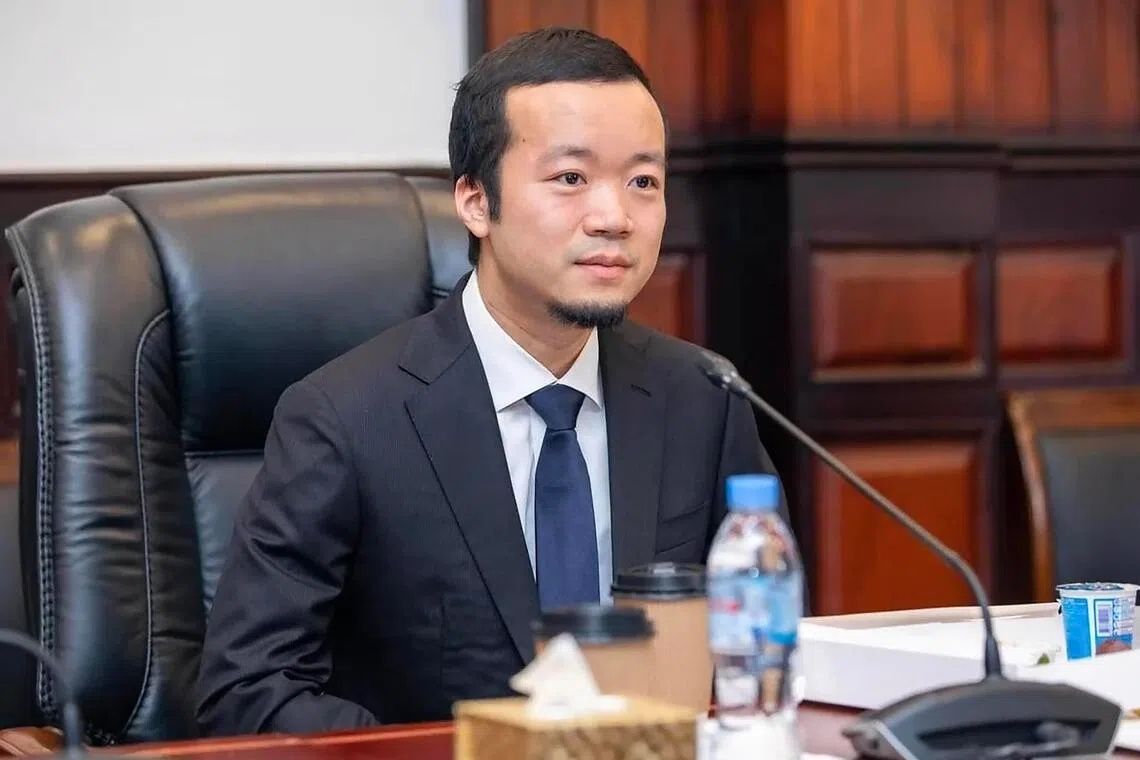
A joint investigation by The Straits Times and the Organised Crime and Corruption Reporting Project has identified Chen Sokly as a principal conspirator in what US prosecutors describe as one of the largest financial fraud operations in modern history. Sokly, who was born Chen Xing in Shanghai in 1986 and later adopted his Cambodian name after gaining citizenship around the end of 2017, served as a critical operational figure within Chen Zhi's Prince Holding Group. The exposure comes six months after their identities were first revealed in a criminal indictment filed in New York on October 8, 2025, marking a significant breakthrough in understanding the internal hierarchy of a syndicate that funnelled billions in illicitly obtained money through an intricate web of shell companies and corrupt officials across multiple continents.
The investigation traced Sokly's global footprint through hundreds of pages of corporate records, property deeds, and government documents spanning multiple jurisdictions including Singapore, Cambodia, Cyprus, and the United States. What emerged was a portrait of sophisticated asset concealment and identity manipulation. Sokly was known by multiple names depending on his geographical location—in Singapore's business circles, he operated as Martin Chen, a façade of legitimacy that masked his role as the syndicate's chief risk officer and fixer. His ability to establish himself across different countries with varying legal identities underscores the operational complexity that enabled the Prince Group to evade detection for years, even as the scheme grew to generate an estimated US$30 million daily at its peak.
According to the indictment, Sokly's primary responsibility was managing the syndicate's exposure to law enforcement investigations. His portfolio included developing relationships with foreign officials willing to obstruct inquiries and negotiating immunity for Prince Group members facing legal jeopardy. In May 2023, prosecutors alleged that Sokly communicated with a Chinese government official who offered to shield Prince Group associates from prosecution in exchange for financial arrangements and favours. The ledgers seized by US authorities revealed a systematic pattern of bribery, including a US$3 million yacht purchase Sokly arranged for a foreign government official in 2019. This institutional corruption represented not mere individual malfeasance but rather a deliberate strategy to weaponise official networks against law enforcement—a dimension that suggests the syndicate's influence extended far beyond criminal underworld into state apparatus itself.
Singapore features prominently in the infrastructure Sokly constructed. In 2017, property records show he purchased a luxury five-bedroom apartment at 10 Leedon Heights valued at S$11 million, establishing an immediate foothold in the city-state's premium residential market. The acquisition signalled his intention to integrate into Singapore's financial ecosystem rather than operate clandestinely. Subsequent corporate filings reveal that over the following two years, Sokly registered himself as a director across at least 16 Singapore-registered entities, clustering several at an address on Shenton Way in the city's financial district. Most of these directorial positions were terminated between 2020 and 2023, a pattern that investigators suggest was designed to obscure ownership trails and complicate asset tracing.
The Shenton Way office address that housed Sokly's web of companies contained only two unrelated businesses, according to an electronic building directory, suggesting the entities may have been largely dormant or shell structures designed primarily for money movement rather than legitimate operations. M Capital Global Holdings, his flagship Singapore vehicle incorporated in 2017, received over S$5 million in initial investment split equally between Sokly and his wife. The company remains registered with both as shareholders, creating a formal ownership structure that would withstand routine regulatory scrutiny while maintaining spousal protection claims useful in asset protection strategies. Former employees who agreed to speak anonymously described Sokly's operational rhythm as episodic—he typically remained in Singapore for two to three months annually, conducting business and socialising with associates including Chen Zhi himself during evening entertainment and dining engagements.
Sokly's material accumulation extended beyond Singapore into California's property market, revealing a deliberate geographic diversification of assets across multiple jurisdictions with varying legal frameworks. In 2019, he purchased a residential property in California, a transaction that connected him to Fang Zhizhen, a member of the Knight Attack Group—a predecessor cybercriminal organisation that predated and foreshadowed the Prince Group's emergence. This connection suggests continuity within China's organised financial crime ecosystem, with experienced operators transitioning between successive criminal ventures. The California property was sold in 2024 for approximately US$4.5 million, generating substantial capital that Sokly subsequently moved to protect. In November 2025, just weeks after the US Treasury imposed sweeping sanctions against the Prince Group, Sokly transferred ownership of a separate US$4 million property to his wife, subsequently placing it within a trust structure operated by her name—a manoeuvre commonly employed to shield assets from forfeiture proceedings.
The enforcement response highlights how international law enforcement has begun coordinating to dismantle the Prince Group's financial architecture. The US government's forfeiture of 127,271 bitcoins valued at approximately US$15 billion represented an unprecedented cryptocurrency seizure, demonstrating authorities' capacity to trace and recover digital assets. Yet Sokly's property transfers in the weeks following sanctions announcement illustrate how sophisticated operators anticipate enforcement actions and implement protective measures to preserve personal wealth even as organisational assets face seizure. The trust structures and spousal transfers employed fall within legal frameworks designed ostensibly for estate planning but function practically as asset defence mechanisms when executed by individuals under investigation.
Sokly's role in the syndicate extended beyond financial engineering into direct operational enforcement. When internal discipline was required—such as addressing a group member accused of theft—Chen Zhi explicitly tasked Sokly with handling the matter, indicating his function encompassed both administrative oversight and the capacity to deploy violence when necessary. This combination of financial acumen, official corruption management, and willingness to employ coercion made Sokly indispensable to Chen Zhi's management structure. His boastful confidence regarding the organisation's reach and official protection reflected genuine operational success; the Prince Group sustained operations for years despite generating billions in suspicious flows that should have triggered regulatory detection.
The investigation's findings carry substantial implications for Southeast Asian financial regulators and law enforcement agencies operating in the region. Singapore, as the primary operational hub where Sokly established his residential and corporate presence, faces questions about how such extensive asset accumulation and corporate structuring escaped regulatory notice during the relevant period. The use of legitimate Singapore corporate vehicles, property purchases in premium locations, and integration into local business networks suggests either regulatory blind spots or the possibility that shell company networks can function effectively within existing compliance frameworks. Financial intelligence units across ASEAN economies must examine whether comparable networks remain operative, utilising similar techniques of jurisdictional shopping and identity multiplication to launder proceeds from cross-border financial crimes and human trafficking operations.
The Prince Group's business model—extracting wealth from coerced workers in Cambodian scam compounds and distributing proceeds through international money laundering—represents a particularly virulent form of transnational organised crime that exploits regional labour vulnerabilities and financial system interconnections. Sokly's architectural role in this system, managing both the corrupt official relationships that enabled operations and the asset concealment mechanisms that preserved personal wealth, demonstrates how sophisticated financial crime requires operational expertise that extends far beyond street-level criminality. The identification and partial disruption of this network through coordinated investigation provides a template for addressing comparable schemes, yet the ease with which Sokly executed property transfers and trust arrangements even after sanctions were announced suggests that asset protection mechanisms continue to function effectively even within sophisticated enforcement environments.

