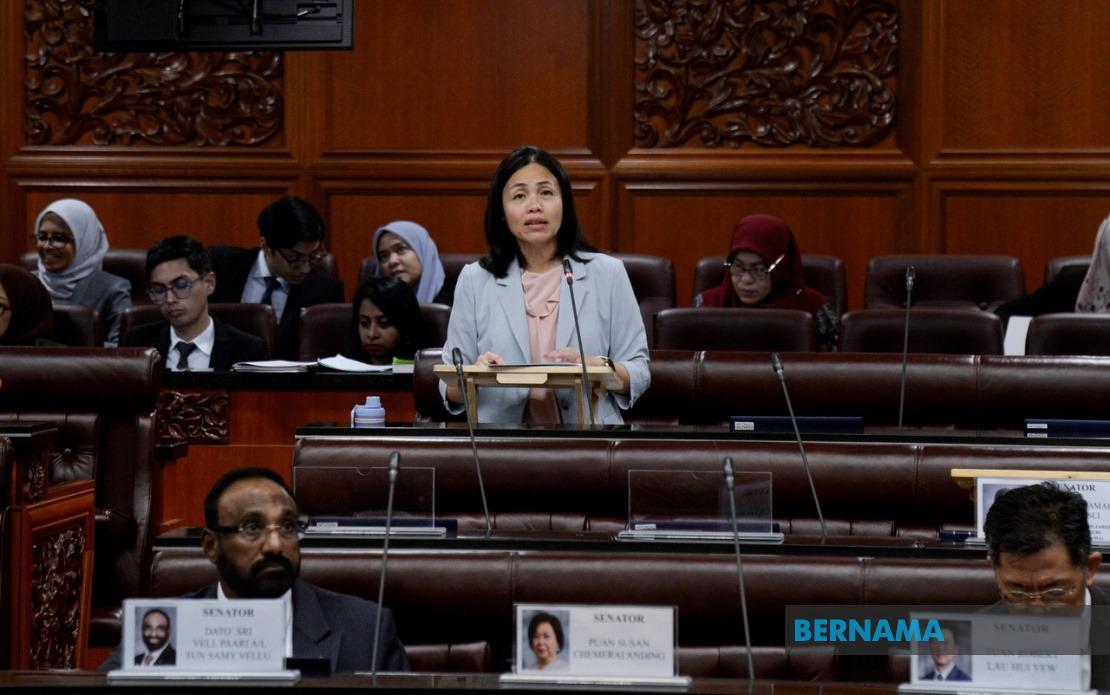
Malaysia's Dewan Negara has approved the Communications and Multimedia Commission (Amendment) Bill 2026, marking a significant step towards insulating the country's digital regulator from political interference whilst expanding its enforcement powers. The legislation cleared the upper chamber on August 3 following debate among 11 senators and now moves toward implementation following its earlier passage in the Dewan Rakyat on July 15. The amendment represents a deliberate recalibration of how Malaysia governs its communications sector at a moment when digital connectivity has become foundational to economic competitiveness and national security.
Deputy Minister of Communications Teo Nie Ching highlighted the immediate practical impact of MCMC's evolving enforcement mandate when presenting the bill's rationale. The communications regulator has demonstrated unprecedented momentum in combating illegal online gambling, removing 222,257 pieces of gambling-related content within just the first seven months of 2026 alone. This acceleration reflects not only MCMC's willingness to act aggressively but also the growing cooperation of social media platform operators in compliance efforts. The contrast with historical performance is stark: only two items were removed in 2022, a figure that exploded to 18,814 by 2023, then 189,484 in 2024, and 289,486 throughout 2025. Simultaneously, enforcement agencies have moved to block access to 6,982 gambling websites between 2022 and July 2026, demonstrating a coordinated approach spanning law enforcement and regulatory authorities.
The operational division of responsibilities between MCMC and the Royal Malaysia Police underscores the amendment's practical architecture. While gambling investigations formally fall within police jurisdiction, MCMC provides the technical backbone—digital forensics, platform analysis, and access denial capabilities—that makes modern enforcement viable. This collaborative structure acknowledges that illegal gambling operates primarily through digital channels where telecommunications infrastructure plays the critical role. By strengthening MCMC's position and clarifying its mandate, the amendment enables the regulator to provide faster, more sophisticated support to law enforcement without requiring police to develop expensive digital expertise in-house. For Malaysian citizens concerned about problem gambling and its social costs, this institutional arrangement promises more effective prevention than traditional policing alone could achieve.
Beyond the gambling enforcement narrative lies a more fundamental governance question that the amendment addresses directly: the independence of Malaysia's communications regulator. The bill explicitly prohibits politicians from serving as MCMC chairman and bars sitting members of Parliament and state assemblies from holding commission positions. Teo emphasised that this restriction aims to ensure appointments rest on qualifications and merit rather than political loyalty or favour. The amendment further constrains ministerial discretion by requiring that individuals appointed to leadership roles possess demonstrable competence in their field. This represents an ideological commitment to technocratic governance in a sector where political interference could distort outcomes, favour certain business interests, or subordinate consumer protection to partisan goals. For investors and technology companies operating in Malaysia, institutional insulation from electoral cycles offers greater predictability and reduces risks associated with regulatory capture.
Senator Datuk Abdul Halim Suleiman articulated the broader strategic context during parliamentary debate, characterising communications and multimedia infrastructure as no longer merely economic sectors but rather critical national assets. This reframing matters considerably. When telecommunications, digital platforms, and multimedia services are understood as strategic infrastructure comparable to electricity grids or water systems, the case for depoliticised, professional regulation becomes stronger. Nations have learned through repeated experience that politicising critical infrastructure governance invites corruption, inefficiency, and vulnerability to external threats. Malaysia's recognition of this principle, embodied in the amendment, positions the country alongside regional peers in treating digital governance as a matter requiring expert stewardship insulated from immediate political pressures. The sector's rapid evolution toward artificial intelligence, 5G deployment, and digital payment systems further elevates the importance of having a technically capable, independent regulator.
Senator Muhammad Hasbie Muda introduced a complementary concern: that structural independence means little without genuine commitment to expert selection, transparent decision-making, and accountability mechanisms. His intervention reflects broader concerns within Malaysia's policy community that regulatory reform often remains superficial—rearranging institutional boxes without ensuring the human capital and procedural discipline necessary for effective implementation. The appointment of commissioners with genuine expertise in telecommunications, cybersecurity, digital platforms, and consumer protection thus becomes a test of whether the amendment achieves its stated objectives. Without rigorous merit-based selection, even a depoliticised MCMC could drift toward regulatory capture by dominant firms, ideological enforcement prioritising certain visions of digital society, or simple bureaucratic inertia.
The substantive content of the amendment extends beyond governance structures to clarify MCMC's functional scope. The bill modifies Section 16 of Act 589 to explicitly address the regulator's responsibility for developing and regulating digital infrastructure standards and platform governance frameworks. This clarification responds to the rapid emergence of new digital services—streaming platforms, social commerce, fintech applications—that existing legislation predated. By formally embedding digital infrastructure and platform standardisation within MCMC's remit, the amendment acknowledges that effective regulation requires not merely policing misconduct but also establishing the technical standards that make legitimate competition and consumer protection possible. For Malaysian businesses expanding into digital services, this clarity reduces regulatory ambiguity whilst signalling government commitment to coherent, forward-looking oversight.
The passage of this amendment also reflects Southeast Asian trends toward regulatory modernisation in digital governance. Regional peers including Singapore, Indonesia, and Thailand have undertaken similar exercises to separate political influence from telecommunications and digital regulation. Malaysia's approach aligns the country with international best practices whilst accommodating local institutional contexts. The emphasis on blocking politicians from MCMC leadership echoes commitments made elsewhere in the region to professional, insulated regulation of sectors vital to economic development. For Malaysian policymakers, this convergence offers opportunities for regional cooperation on shared digital challenges—cross-border gambling, cybersecurity threats, platform accountability—that require consistent regulatory standards.
The practical enforcement gains already visible in gambling content removal suggest that MCMC's expanded mandate and resources are translating into tangible results. The geometric progression in content removals year over year indicates that once regulatory focus intensified and platform cooperation mechanisms matured, enforcement capacity scaled rapidly. This trajectory offers lessons for other digital harms MCMC might address: cyberbullying, misinformation, predatory lending schemes, and intellectual property infringement all follow similar dynamics where initial enforcement investments create network effects that accelerate subsequent action. The amendment thus positions MCMC to expand its enforcement reach across multiple domains as institutional capacity and stakeholder cooperation develop.
Looking forward, the amendment's success depends on the calibre and commitment of individuals appointed to lead the reconstituted MCMC. The regulatory independence that the bill provides creates space for professional judgment, but only capable, principled leaders can fill that space productively. Malaysia's experience with other autonomous regulatory bodies offers mixed lessons: some have become models of efficient, expert governance whilst others have drifted toward paralysis or clientelism. The explicit prohibition on political appointments represents necessary but insufficient institutional safeguarding. Democratic oversight mechanisms, transparent decision-making procedures, and robust accountability to affected constituencies remain essential complements to independence. As Malaysia's digital economy matures and regulatory challenges multiply, MCMC's evolution from a relatively technical body to a strategic governance institution managing critical infrastructure warrants sustained attention from lawmakers, civil society observers, and business stakeholders alike.

