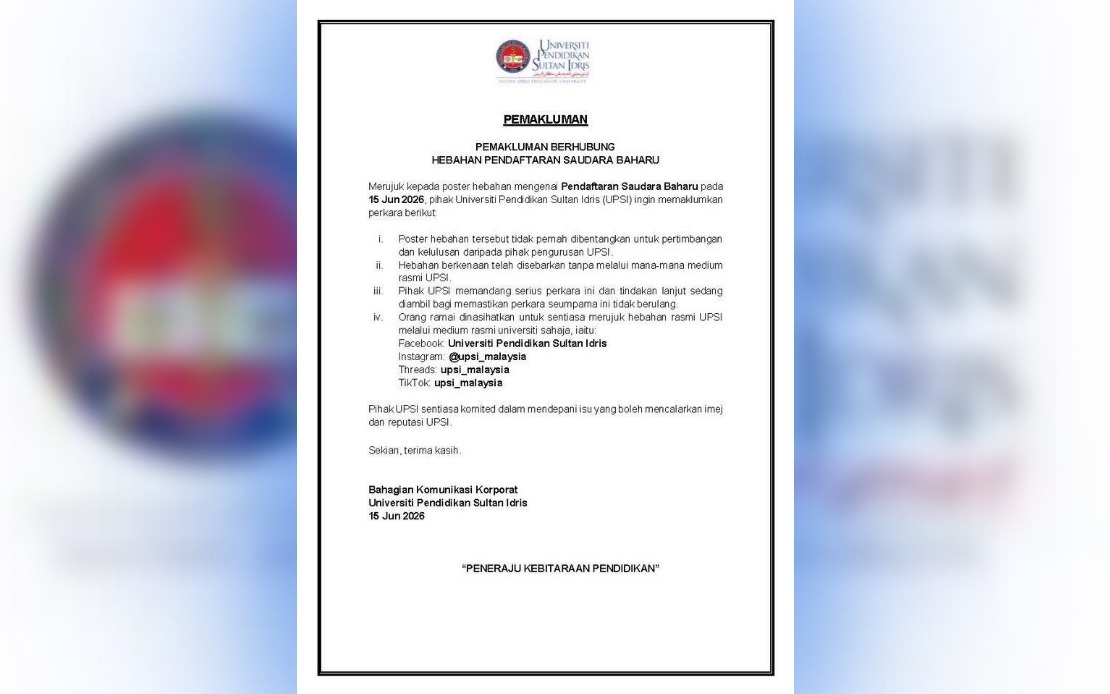
Universiti Pendidikan Sultan Idris (UPSI) has moved swiftly to distance itself from a poster concerning the registration of 'saudara baharu' or newly converted Muslims that recently gained traction across social media platforms. The institution released a statement through its official social media accounts denying any institutional role in creating or endorsing the material, which bore a June 15 date stamp.
According to UPSI's response, the poster in question never reached the university's administrative leadership for formal review or endorsement. The university emphasised that the document circulated entirely outside its established official communication frameworks, suggesting it was independently shared without institutional sanction. This distinction is significant in Malaysia's higher education context, where universities typically maintain strict protocols governing materials released under their name or perceived to represent their values.
The timing and nature of the poster's emergence has raised questions about how unofficial content can gain credibility online by association with reputable institutions. The viral spread demonstrates the vulnerability of universities to reputational risks when third parties create content that mimics official communications or appears to carry institutional authority. For UPSI, the incident underscores broader challenges facing Malaysian educational institutions in the digital age, where misinformation or unauthorised content can rapidly accumulate engagement and perceived legitimacy.
UPSI's statement committed the university to taking further action to prevent similar occurrences, signalling an intention to strengthen internal protocols around content verification and approval. The university also urged the public to refer exclusively to announcements distributed through its verified official channels, a standard practice among Malaysian institutions seeking to combat impersonation or false attribution. This guidance reflects institutional responsibility in an environment where social media literacy remains inconsistent across different demographic groups.
The incident touches on a sensitive area within Malaysian society. Discussions involving religious conversion and Muslim integration require careful institutional stewardship, particularly within educational settings that serve diverse student populations. Universities in Malaysia function as spaces where multiple faith communities coexist, making institutional clarity about unauthorised communications especially important to prevent misunderstandings or community tensions.
For Malaysian higher education more broadly, the UPSI case illustrates an emerging vulnerability that institutions have had to confront repeatedly. As social platforms become primary channels for information dissemination, the gap between official and unofficial content has narrowed in public perception. Without clear verification mechanisms or digital literacy initiatives, audiences often struggle to distinguish authorised from unauthorised institutional communications, a challenge that affects reputation management across multiple sectors.
The university's commitment to addressing the situation reflects institutional accountability standards expected within Malaysia's academic sector. UPSI's proactive communication strategy through social media channels demonstrates recognition that denial alone is insufficient; institutions must actively manage their digital footprint and educate stakeholders about verification protocols. This represents a shift toward more sophisticated institutional communication practices in response to evolving media landscapes.
Beyond UPSI's specific situation, the episode raises questions about the broader ecosystem of online content creation and shareability. Sophisticated actors or even well-intentioned individuals can generate convincing materials that exploit institutional logos, formatting conventions, and familiar language patterns to gain undeserved credibility. The ease with which such content can circulate before verification creates challenges for institutions in protecting their reputational integrity and maintaining public trust.
For Malaysian readers and stakeholders in higher education, this incident serves as a reminder of the importance of verification habits when encountering institutional announcements online. The proliferation of unofficial content bearing institutional markers has made critical engagement with digital information increasingly necessary. UPSI's explicit guidance to consult official channels exclusively aligns with broader public health and information security best practices that emphasise source verification before sharing or acting on information.
The university's statement also reflects institutional recognition that reputational management requires transparency and swift response. By publicly clarifying its position and committing to preventative measures, UPSI demonstrates understanding that stakeholder confidence depends on clear communication and demonstrated accountability. This approach contrasts with institutional silence, which can allow misinformation to persist and potentially damage institutional credibility more severely.
Moving forward, the incident may prompt Malaysian universities to review their social media governance frameworks and explore enhanced verification technologies or protocols. The challenge of distinguishing authorised from unauthorised content will persist as long as social platforms remain relatively open to content creation and sharing. Institutions that invest in proactive communication strategies, digital literacy initiatives, and robust content verification systems will likely find themselves better positioned to navigate these challenges while maintaining stakeholder trust and institutional reputation.