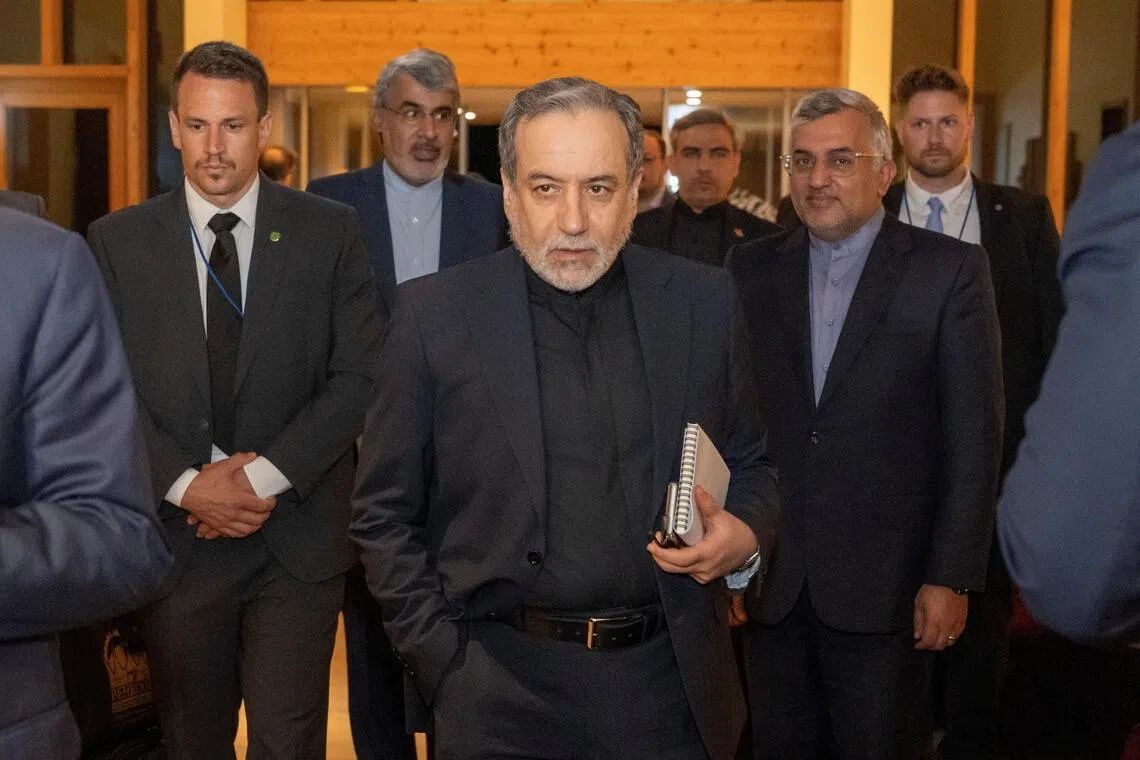
Negotiations aimed at forging a durable ceasefire between the United States and Iran have begun at an exclusive Swiss resort, marking the first high-level direct talks since the two powers signed an interim peace agreement four days earlier. Vice President JD Vance arrived at the Buergenstock resort on Sunday morning to lead the American delegation, joining Iranian chief negotiator Mohammad Baqer Qalibaf and representatives from mediating nations including Pakistan. The talks represent a pivotal moment in regional diplomacy, with both sides attempting to transform a fragile 60-day ceasefire into a comprehensive settlement that addresses not only the immediate military conflict but also underlying disputes over nuclear weapons and Lebanon's future.
The timing and location of these discussions underscore the gravity of the undertaking. Buergenstock, a secluded Alpine property owned by Qatar, sits atop a Swiss mountain accessible only through winding roads and multiple security checkpoints, providing the isolation necessary for sensitive negotiations. Vance and second lady Usha Vance arrived after landing at a nearby military base, while the Iranian delegation brought together Foreign Minister Abbas Araqchi alongside senior officials from the central bank, defence ministry, and energy sector. Pakistan's Prime Minister Shehbaz Sharif and army chief Field Marshal Syed Asim Munir also joined, reflecting Islamabad's instrumental role in brokering the initial agreement signed by Presidents Donald Trump and Masoud Pezeshkian on Wednesday.
Yet the commencement of formal talks is clouded by immediate friction over one of the world's most economically vital waterways. Iran's Islamic Revolutionary Guard Corps declared the Strait of Hormuz closed on Saturday, citing Israeli military operations in Lebanon as a violation of ceasefire commitments. The strait carries approximately one-fifth of global petroleum supplies, making such assertions consequential for energy markets worldwide and for economies heavily dependent on stable oil flows, including many Southeast Asian nations. However, the United States military dismissed Iran's claims, reporting that 55 merchant vessels successfully transited the waterway on Saturday carrying more than 17 million barrels of oil destined for international markets. This contradiction highlights the fundamental challenge facing negotiators: each side accuses the other of bad faith implementation, threatening to undermine confidence in any agreement reached.
The Lebanon ceasefire, ostensibly a prerequisite for nuclear-focused negotiations, is proving equally fragile. Although a truce theoretically commenced, Israeli forces and the Iran-backed militant organisation Hezbollah exchanged fire on Saturday. Lebanese health ministry figures document 4,057 deaths since March, though official records do not specify how many were combatants versus civilians and medical personnel. Israeli authorities report 32 soldiers and four civilians killed in fighting with Hezbollah, and the military maintains it is not bound by the Iran-US agreement and will retain control of occupied Lebanese territory. This stance creates a fundamental asymmetry: while Washington and Tehran negotiate, one of the primary combatants—Israel—remains outside the formal framework, yet retains the capacity to derail agreements through unilateral military action. The continued violence on Saturday, occurring mere hours after the truce took effect, suggests that translating ceasefire declarations into sustained calm will demand constant diplomatic intervention.
The American negotiating team, alongside Vance, includes envoy Steve Witkoff and Jared Kushner, Trump's son-in-law, signalling the Trump administration's personal investment in achieving a settlement. Vance expressed confidence before departing the United States that the ceasefire would endure and stated he had observed no evidence of a closed Strait of Hormuz, positioning the American side as pragmatic and reality-based. However, Iranian officials contest this characterisation. Mohammad Mokhber, an adviser to Supreme Leader Ayatollah Mojtaba Khamenei, accused Washington of failing to implement the first of fourteen agreed points, which include comprehensive ceasefire provisions. This disagreement reflects deeper suspicion: Iran has experienced broken commitments in past negotiations and approaches these talks with historical wariness. Iranian Oil Minister Mohsen Paknejad, by contrast, offered an alternative framing, suggesting that if Western parties honour the agreement's spirit, hundreds of investment and commercial opportunities await, potentially signalling Iran's readiness to normalise economic relations should trust be established.
President Trump injected an additional complication into the diplomatic environment by invoking the possibility of American-imposed tolls on Strait of Hormuz traffic should negotiations fail. In social media statements, he referenced potential charges "for services rendered as the Guardian Angel to the countries of the Middle East," effectively threatening economic leverage if a comprehensive peace deal is not completed within the 60-day window. This conditional framing, whilst asserting American interests, also creates uncertainty for regional and global stakeholders dependent on free passage through the waterway. For Southeast Asian economies particularly—given their substantial reliance on Middle Eastern energy imports and their vulnerability to supply disruptions—such rhetoric raises questions about the stability of energy markets during the negotiation period and beyond. Trump simultaneously pledged that no tolls would be imposed during the ceasefire or afterwards unless negotiations collapse, attempting to reassure international markets whilst preserving American negotiating leverage.
Public opinion within Israel complicates the diplomatic landscape further. A Hebrew University poll indicates that approximately 92 per cent of Israelis believe Iran benefited disproportionately from the joint Israeli-American military campaign, with only eight per cent viewing their nation as having achieved victory. Nearly 90 per cent of respondents reported that war objectives remained unmet, and fewer than 30 per cent credited Prime Minister Benjamin Netanyahu's assertions of major accomplishments. This domestic sentiment creates political pressure on the Israeli government to resist concessions and maintain military readiness, even as American and Iranian negotiators attempt to cement peace arrangements. Israel's stated position—that it is not party to the Iran-US deal and will sustain military deployments in Lebanon—reflects this domestic political reality and suggests that Israeli-American alignment on ceasefire enforcement cannot be assumed.
The substance of the negotiations will address two distinct yet interconnected domains. First are nuclear issues, where Iran seeks relief from international sanctions in exchange for constraining its weapons programme, returning to frameworks abandoned after the Trump administration's 2018 withdrawal from the Joint Comprehensive Plan of Action. Second is the Lebanon conflict, where establishing sustainable separation between Hezbollah and Israeli forces requires external guarantees and enforcement mechanisms. Vance indicated before departure that the delegations anticipated conducting talks over "a couple of days," suggesting an ambitious timeline for addressing these multifaceted questions. The 60-day ceasefire window provides a structured deadline, yet compressing complex negotiations within this timeframe whilst managing ongoing military tensions presents substantial challenges.
For Malaysia and other Southeast Asian nations, the outcome of these talks carries significant implications. Regional energy security depends substantially on uninterrupted flow through the Strait of Hormuz, making any prolonged closure or instability economically destabilising. Additionally, regional geopolitical stability benefits from US-Iran de-escalation, reducing the risk of broader conflict that could disrupt trade routes and investment patterns. Malaysia's substantial trading relationships with both American and Iranian partners, along with its strategic location along maritime trade corridors, align Malaysian interests with successful negotiation outcomes. The talks also carry implications for the broader regional architecture, as successful US-Iran reconciliation could reshape Middle Eastern alignments and potentially alter dynamics affecting Southeast Asian security partnerships and economic cooperation.
The fundamental challenge confronting negotiators extends beyond specific terms to encompass mutual trust and verification mechanisms. Both sides have articulated commitment to the interim agreement, yet their contradictory claims regarding Strait of Hormuz closure and competing accusations of ceasefire violations suggest that differing interpretations of obligations persist. Iranian officials emphasise historical precedent of broken agreements by Western parties, whilst American negotiators stress their commitment to implementation. This mutual suspicion, rooted in decades of animosity and past diplomatic failures, means that even technical agreements require confidence-building measures and transparent monitoring. The presence of Pakistani mediators and Qatari facilitation suggests that third-party monitoring and intermediation will likely feature prominently in any comprehensive settlement.
As delegates begin their conversations in the Alpine setting, the international community watches for signals of genuine progress. The coming days will reveal whether negotiators can translate ceasefire mechanics into durable political settlements, whether verification and enforcement mechanisms can be agreed, and whether the underlying regional dynamics—particularly Israeli positioning and Hezbollah's role—can be managed within a framework acceptable to all parties. The talks occur against a backdrop of genuine urgency; the 60-day window imposes temporal constraints, and further military incidents could rapidly unravel the fragile ceasefire. Success would represent a significant diplomatic achievement with implications extending beyond the immediate combatants to reshape Middle Eastern geopolitics and affect energy security and trade patterns across Asia-Pacific regions.

