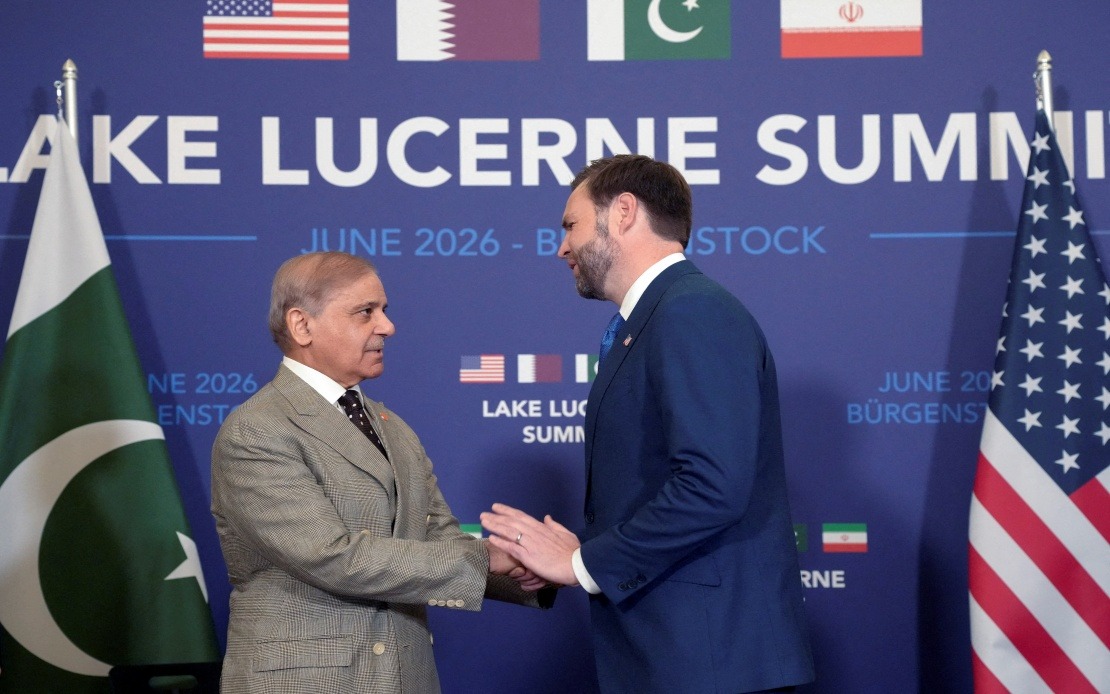
Senior United States officials convened with Pakistani leadership at the Swiss resort of Burgenstock on Sunday, marking a significant diplomatic engagement as broader negotiations between Washington and Tehran entered a crucial phase. Vice President JD Vance, alongside special envoys Steve Witkoff and Jared Kushner, greeted Pakistan's Prime Minister Shehbaz Sharif and Pakistan Army Chief Field Marshal Asim Munir in what the White House press pool described as a bilateral meeting already underway at the mountain resort.
The gathering in Switzerland reflects the complex geopolitical landscape of the Middle East and South Asia, where Pakistan occupies a pivotal strategic position. As a nuclear-armed nation with longstanding ties to both the United States and influence across the Islamic world, Pakistan's involvement in facilitating regional stability carries considerable weight. The presence of both the Prime Minister and the Army Chief underscores the institutional importance Islamabad places on these discussions, suggesting coordinated decision-making at the highest levels of Pakistani governance.
The bilateral encounter occurred within the broader context of technical-level negotiations between Iran and the United States, which commenced in Burgenstock on the same day. Pakistan and Qatar were positioned as mediators in these discussions, scheduled to proceed behind closed doors. This architectural arrangement—involving multiple stakeholders in parallel meetings—illustrates the layered diplomacy required to address entrenched regional tensions.
Understanding the backdrop to these negotiations proves essential for regional observers. In the overnight period preceding June 18, Iran and the United States executed a remotely signed memorandum designed to terminate military hostilities that commenced on February 28. This agreement represents a dramatic shift in bilateral relations, moving from active conflict toward negotiated settlement. The accord establishes specific mechanisms and timelines, including provisions for the United States to withdraw its naval blockade while Iran commits to restoring shipping corridors through the strategically vital Strait of Hormuz.
The nuclear question remains at the heart of US-Iran tensions, and the memorandum addresses this through a dual-track approach. Iran has pledged not to pursue nuclear weapons acquisition, with the technical details of Iran's nuclear programme to be resolved through a separate, dedicated agreement. This compartmentalisation allows negotiators to advance on the immediate conflict cessation while deferring the more complex nuclear architecture to specialised discussions.
The timeline established for nuclear negotiations carries particular significance. The parties have allocated a 60-day window to conclude discussions on Iran's nuclear programme, a relatively compressed schedule reflecting the urgency both sides attach to resolution. This deadline suggests mutual recognition that extended deliberation risks undermining the fragile rapprochement achieved through the memorandum.
For Tehran, the strategic objective underlying these negotiations centres on sanctions relief. The Iranian government views the lifting of international economic sanctions as the primary tangible benefit justifying its diplomatic concessions. Years of stringent restrictions have severely constrained Iran's economy, limiting oil exports and access to international financial systems. The promise of sanctions removal thus constitutes the principal incentive driving Iranian participation in the negotiation process.
The involvement of Pakistan and Qatar as mediators reflects their respective geopolitical interests and capabilities. Qatar, as host to multiple international forums and dialogue mechanisms, brings institutional experience in facilitating regional negotiations. Pakistan's role stems from its geographic proximity to both Iran and Afghanistan, coupled with its strategic partnership with the United States. Pakistani decision-makers understand that regional stability benefits their own security environment, particularly given ongoing challenges in managing the Afghan border and countering extremism.
For Malaysian and Southeast Asian observers, these developments carry several implications. The Middle East remains a critical source of energy resources for the region, and any disruption to shipping through the Strait of Hormuz directly affects supply chains and energy costs across Asia. The restoration of Iranian shipping capacity, contingent on successful negotiations, therefore holds material significance for the region's economic interests. Additionally, the precedent of multilateral diplomacy involving mediators from the Islamic world—Pakistan and Qatar—demonstrates pathways for conflict resolution that may inform regional approaches to other disputes.
The composition of the US delegation also merits examination. The inclusion of special envoys Witkoff and Kushner, the latter known for his involvement in Middle East diplomacy during the previous US administration, suggests continuity in American engagement despite political transitions. This consistency may provide reassurance to parties concerned about the durability of agreements reached under changing administrations.
The practical architecture of these talks—conducting technical discussions simultaneously while senior leaders confer separately—enables substantive progress on specific issues while preserving high-level political flexibility. Should technical discussions encounter impasses, senior-level meetings can address blocking issues or adjust negotiating parameters. This structure has proven effective in previous international negotiations where multiple stakeholder interests require coordination.
Moving forward, the success of these negotiations will significantly shape regional dynamics for years to come. A comprehensive agreement addressing both military conflict cessation and nuclear concerns could reduce tensions that have periodically escalated into direct confrontation. However, the involvement of multiple actors—the United States, Iran, Pakistan, Qatar, and potentially other regional powers—means that implementation will require sustained political commitment and careful attention to the specific concerns each party brings to the table.

