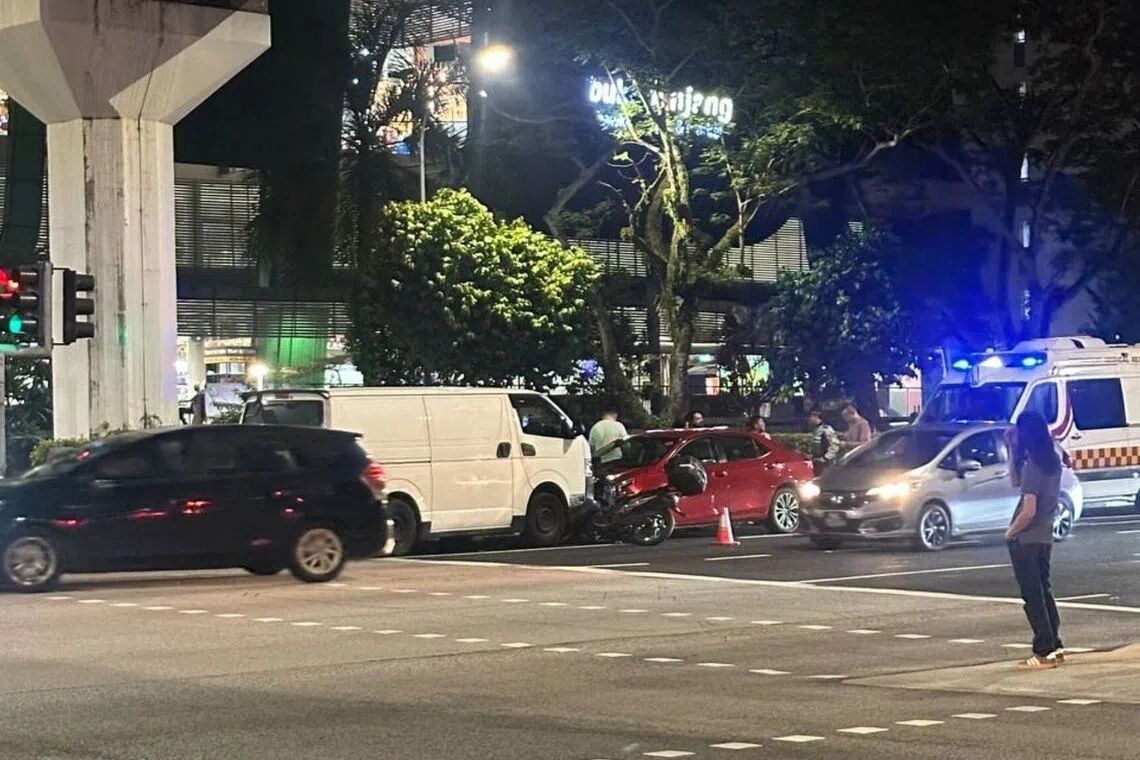
A multi-vehicle collision in Singapore's Bukit Panjang district has resulted in the arrest of a van driver on suspicion of operating the vehicle while under the influence of narcotics. The incident unfolded on Friday evening along Bukit Panjang Road near its intersection with Bukit Panjang Ring Road, prompting a rapid response from both police and emergency services who arrived at the scene shortly after 9pm.
The 27-year-old driver is now in custody facing allegations of drug-impaired driving, marking another instance of traffic enforcement addressing substance-related offences on Singapore roads. Beyond the primary charge, authorities have also recovered vaporising devices and accompanying cartridges from the van, prompting a separate referral to the Health Sciences Authority for assessment of potential regulatory violations.
The accident involved at least four separate vehicles: the van itself, a motorcycle, and two private cars. Emergency responders documented that two individuals sustained minor injuries in the collision, though both declined medical transport to hospital facilities. The precise circumstances surrounding how the vehicles came into contact remain subject to ongoing police investigation.
Social media documentation of the accident scene provides telling visual evidence of the incident's severity. Footage circulated on Instagram account sgfollowsall shows the van positioned head-on against a red sedan, with a motorcycle trapped between the two larger vehicles—a configuration suggesting a significant impact. Behind this cluster, a black sedan sits several metres back, indicating the possibility of a chain-reaction collision typical in multi-vehicle accidents.
Most notably, the van appears to have been travelling counter to the normal traffic direction at the moment of impact, a detail that may prove significant in determining culpability and whether impaired driving contributed to directional confusion or loss of vehicle control. Such reverse-flow collisions often carry heightened risk profiles given the limited reaction time available to other road users.
The vaping devices recovered represent an increasingly scrutinised aspect of traffic safety investigations in Singapore. While vaporiser use has become prevalent globally, particularly among younger demographics, regulatory authorities continue examining potential links between vaping and driving impairment. The Health Sciences Authority's involvement suggests the devices will undergo testing to determine their contents and whether they contained substances capable of impairing cognitive function or motor control.
This incident reflects Singapore's sustained commitment to tackling drug-driving, an offence that carries serious consequences under local traffic law. The intersection of recreational drug use and vehicle operation remains a persistent public safety challenge across Southeast Asia, with Malaysia similarly grappling with impaired driving prevention measures. The arrest underscores how enforcement agencies increasingly interconnect multiple investigative angles—from initial substance suspicion to follow-up examination of ancillary items like vaping equipment.
The timing of the collision during evening rush hours—approximately 9pm on a Friday—suggests the area was likely experiencing moderate to heavy traffic volume. The involvement of a motorcycle, often operated by delivery personnel or commuters in dense urban environments, adds another dimension to the accident's human impact. Such collisions disproportionately affect motorcycle riders, who lack the protective enclosure available to car occupants.
For Malaysian readers observing regional traffic safety developments, this incident underscores the importance of robust enforcement against impaired driving regardless of the substance involved. Singapore's multi-agency response model—involving police investigation, civil defence mobilisation, and health authority referral—demonstrates how jurisdictions are developing integrated approaches to tackle substance-related traffic offences beyond traditional alcohol enforcement.
The ongoing investigation will likely determine whether the van driver's suspected narcotics use directly caused the collision or merely contributed to unsafe driving conditions. Police inquiries typically examine blood tests, toxicology screens, and witness statements to establish the connection between substance impairment and the accident sequence. The availability of video evidence from bystanders may accelerate the investigation timeline.
As Singapore continues strengthening its traffic safety protocols, incidents like this prompt broader conversations about substance detection technologies, roadside testing procedures, and how emerging consumption methods—particularly vaping—fit within existing regulatory frameworks. The Health Sciences Authority's assessment will likely inform future policy considerations regarding vaporiser regulation and driving impairment standards.
The collision serves as a stark reminder that traffic accidents extend consequences beyond immediate injury and property damage. The psychological impact on uninvolved motorists, emergency responders, and the broader community reflects the cascading effects of single moments of impaired decision-making on the road. As investigations proceed, authorities will seek to establish the complete sequence of events and determine appropriate charges reflecting the severity of the driving conduct involved.

