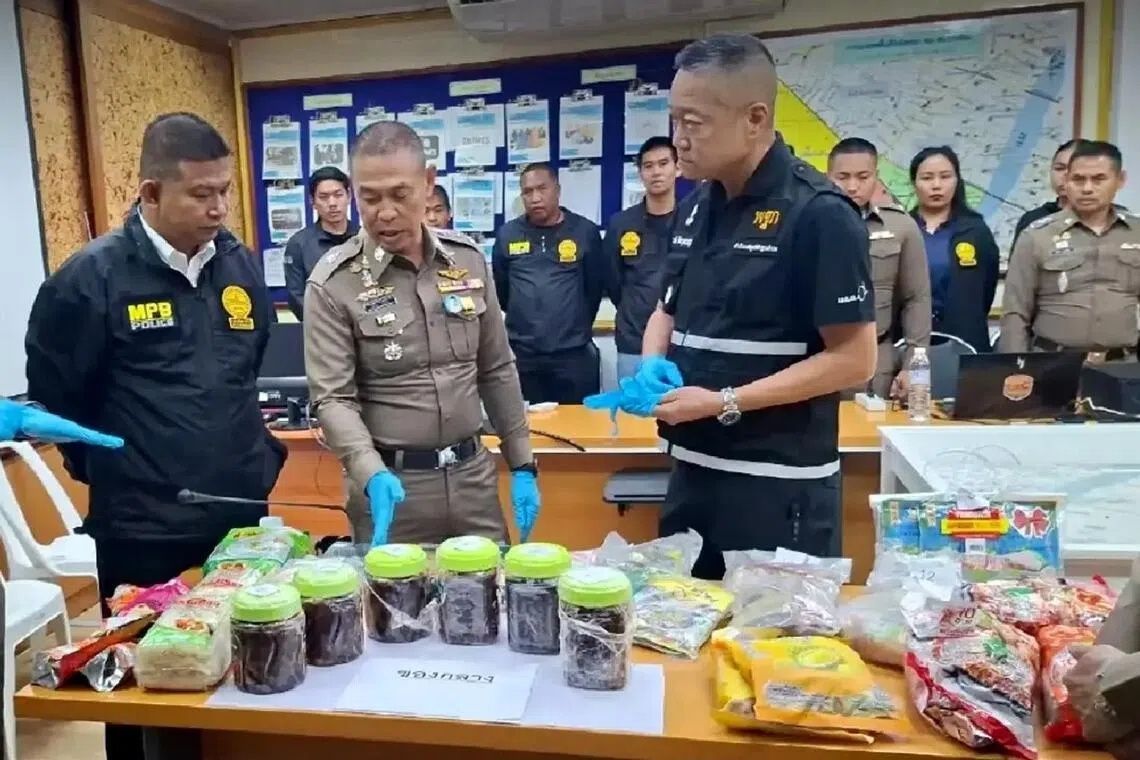
Bangkok police have uncovered an international drug smuggling conspiracy centred on a Vietnamese-led network that exploited Thailand's position as a regional transit hub to funnel crystal methamphetamine into Japan. The operation came to light after authorities arrested a Thai suspect connected to the ring and subsequently discovered a shipment of tamarind paste containers concealing illicit drugs destined for Tokyo. Metropolitan Police Bureau commissioner police lieutenant-general Siam Boonsom, alongside police major general Chaiya Phetpanya, commander of Metropolitan Police Division 7, announced the breakthrough on July 17 following investigations coordinated by Bang Yi Khan Police Station.
The case emerged when an unsuspecting courier grew alarmed about the weight of tamarind jars slated for delivery to Japan and alerted law enforcement on July 13. Upon examination, investigators extracted six foil-wrapped packages from within the containers, with laboratory analysis subsequently confirming the presence of more than 2kg of crystal methamphetamine, colloquially termed ice. The discovery illustrated a troubling trend across Southeast Asia whereby criminal networks exploit ordinary goods and unwitting logistics workers to transport narcotics across borders, transforming Thailand into a critical node within broader international trafficking networks.
Police investigations revealed a hierarchical organisational structure designed to insulate senior operators from direct involvement in the physical movement of drugs. Vietnamese nationals orchestrating the scheme allegedly directed operations remotely from Hanoi, employing digital intermediaries and compartmentalised roles to obscure the supply chain. The network leveraged anonymous Facebook accounts to recruit delivery riders tasked with collecting packages from Thai residences occupied by Vietnamese nationals, who then transferred the consignments to separate Thai couriers hired to carry them overseas. This deliberate fragmentation created multiple operational layers intended to frustrate law enforcement efforts to trace contraband backwards toward the network's architects.
The financial architecture underpinning the smuggling operation revealed equally sophisticated concealment techniques. Payments and operational expenses flowed through a bank account registered to Sompong, the Thai arrest suspect, who maintained only indirect visibility within the broader network. Vietnamese operatives systematically withdrew cash sums ranging from 20,000 to 50,000 baht from the account before returning across the border to Vietnam. This pattern of frequent, modest cash extractions by rotating individuals represented a deliberate strategy to minimise financial footprints and distribute apparent culpability, making forensic tracking substantially more difficult for investigators attempting to reconstruct money flows.
The operational model employed by this network reflects evolving tactics deployed by Southeast Asian organised crime syndicates seeking to penetrate international drug markets. Rather than attempting to move larger quantities through conventional channels, the syndicate fragmented shipments into smaller batches concealed within legitimate commercial goods, thereby reducing the risk profile of each individual transaction. Thailand's role as a crossroads for tourism, trade, and logistics creates natural cover for such operations, where shipping containers, food products, and courier services move continuously across borders. The discovery underscores how regional trafficking networks exploit these legitimate commercial flows to move contraband between source and destination markets.
Arrest warrants have been issued for four individuals: Sompong and three Vietnamese nationals implicated in withdrawing cash, operating social media recruitment accounts, or directing operational components. Sompong has categorically denied involvement in the conspiracy. Investigators also identified Sompong's girlfriend as a person of interest, suspecting she may have possessed knowledge of the operation, though she has not been formally charged. The incomplete apprehension of key network members suggests that significant elements of the smuggling infrastructure remain active and unravelled, with senior organisers potentially continuing operations from Vietnam despite the exposure of this particular trafficking corridor.
The case illuminates broader challenges confronting Thai and Southeast Asian law enforcement agencies as they contend with increasingly sophisticated transnational drug networks. Traditional interdiction approaches targeting major shipments prove insufficient against criminal organisations that employ compartmentalisation, dispersed supply chains, and recruitment of marginal operatives insulated from core decision-making structures. The Vietnamese headquarters model demonstrates how neighbouring countries have become staging grounds for operations targeting distant markets, with operators managing networks across multiple national jurisdictions simultaneously. This geographic diffusion complicates legal pursuit and requires enhanced cross-border intelligence sharing and coordination mechanisms that currently remain underdeveloped across the region.
For Malaysia and other Southeast Asian nations, this case carries immediate operational relevance. Criminal networks employing similar tactics—concealing drugs in food products, recruiting couriers through social media, fragmenting supply chains across multiple territories—may already be active within Malaysian logistics networks. The sophisticated financial laundering techniques identified in this investigation, particularly the use of bank accounts controlled by local operatives to obscure Vietnamese funding sources, represent tactics that Malaysian authorities should anticipate in their own enforcement actions. Enhanced scrutiny of international shipments of Southeast Asian food products and tighter monitoring of suspicious cash withdrawal patterns could strengthen detection capabilities.
The investigation also underscores the strategic importance of intelligence cooperation among regional police forces and drug enforcement agencies. The exposure of Vietnamese operational control over Thai-based logistics networks suggests that intelligence regarding shipping routes, recruitment methods, and financial conduits should circulate rapidly throughout ASEAN law enforcement structures. Information gaps between national agencies remain a fundamental vulnerability that criminal networks exploit. Establishing more formal mechanisms for real-time intelligence sharing regarding suspected smuggling operations, identified couriers, and financial accounts used by international drug syndicates could substantially degrade the operational capacity of these networks before they successfully deliver contraband.
The broader implication of this case extends to the relationship between Thailand's role as a regional hub and its vulnerability to exploitation by international criminal enterprises. While Thailand benefits substantially from its position as a commercial, logistical, and tourism centre, these very characteristics create opportunities for smugglers seeking to move illicit goods through established trade corridors. Balancing commercial facilitation with effective narcotics interdiction remains an ongoing challenge for Thai authorities, particularly as criminal networks continuously adapt their methods to circumvent detection. The use of legitimate tamarind paste shipments to conceal methamphetamine represents a relatively low-technology approach yet proved effective until the courier's suspicions triggered examination.

