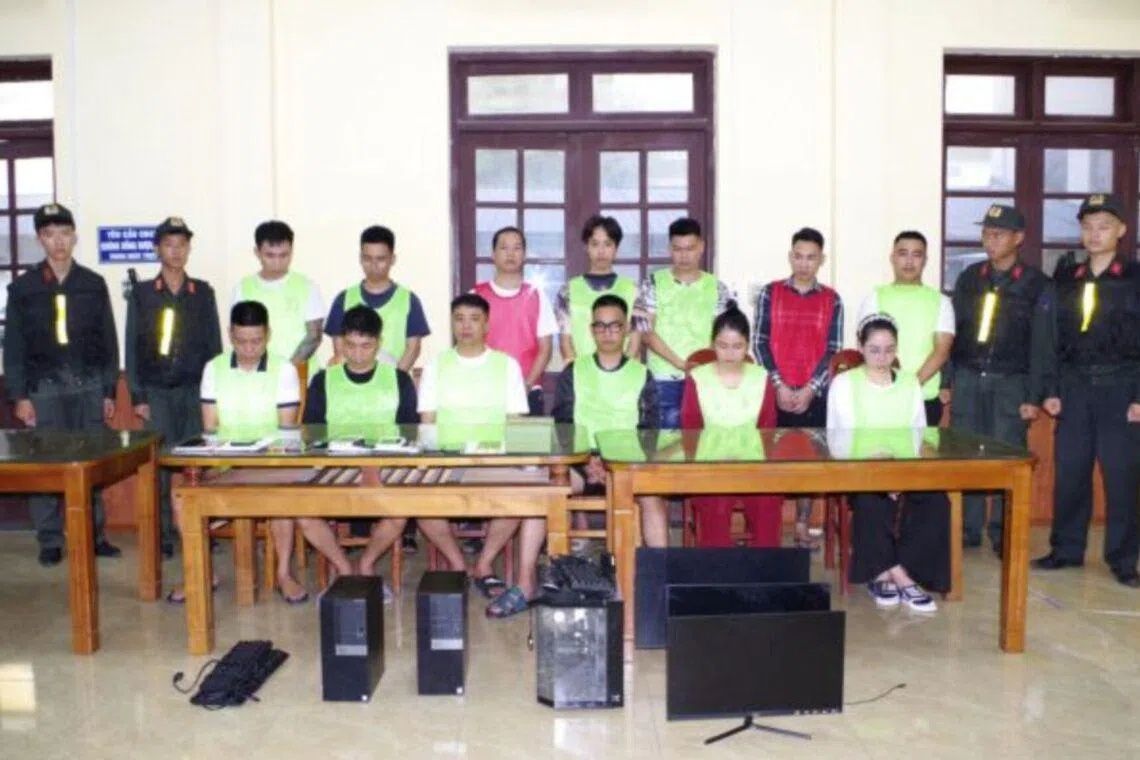
Police in Vietnam's northern Ninh Binh province have successfully rolled up a sophisticated transnational online fraud operation, detaining 12 suspects implicated in a scheme that has victimised roughly 500 people and netted criminals more than RM39.2 million in illicit gains. The breakthrough came after investigators traced the complex network's operations and conducted coordinated raids that yielded substantial physical evidence, including cash, vehicles, mobile devices, computers, forged identification documents, jewellery, and extensive operational records.
At the centre of the criminal enterprise are two alleged masterminds: Nguyen Van Cuong, 28, and Nguyen Van Phuong, 34, who orchestrated the recruitment and coordination of participants across borders. What makes this case particularly significant for the region is the deliberate transnational structure—the organisers systematically transported Vietnamese nationals to Cambodia, where they could operate with greater anonymity and reduced risk of immediate apprehension. This geographical separation between recruitment and operational bases represents a common evolving pattern in Southeast Asian cybercrime, where criminals exploit regulatory gaps and jurisdictional complexities to insulate themselves from law enforcement.
The operational sophistication of this ring underscores how modern fraud networks have evolved far beyond simple email scams. The group deployed an elaborate hierarchy with clearly delineated roles and responsibilities, suggesting a corporate-like structure designed to compartmentalise knowledge and minimise individual exposure if one element of the operation unravelled. Members specialised in specific functions, from identity impersonation to technical website manipulation to social engineering, indicating substantial planning and investment in capability development.
Among their most brazen tactics was the wholesale impersonation of authority figures—police officers, prosecutors, judges, bank employees, and tax officials. By adopting official personas, the fraudsters leveraged the inherent trust Vietnamese citizens place in government institutions to overcome natural scepticism and accelerate victims toward financial commitment. This exploitation of institutional authority reflects a deeply cynical understanding of human psychology and social dynamics within Vietnamese society.
The technical dimension of the scheme reveals considerable expertise. The network created counterfeit websites and mobile applications meticulously designed to replicate government agencies and legitimate commercial platforms. The quality of these forgeries was apparently convincing enough to deceive ordinary users, suggesting the fraudsters either employed individuals with genuine web development skills or purchased ready-made phishing kits from underground marketplaces. Creating convincing digital replicas requires not merely aesthetic accuracy but also functional realism—payment gateways must appear operational, form submissions must seem to process correctly, and security indicators must look authentic.
The range of scam vectors deployed by the network demonstrates adaptability and market awareness. Fake job recruitment schemes targeting individuals seeking part-time income tap into economic anxieties and the appeal of flexible work. Investment frauds in finance, securities, and cryptocurrency exploit both the aspirational desire for wealth accumulation and the technical opacity of digital assets that makes them difficult for ordinary people to verify. Romance scams leverage emotional vulnerability and the desire for human connection. Social media account hijacking provides a direct conduit to victims' trusted networks, adding false authenticity through compromised accounts that appear to belong to people the victim knows.
Particularly inventive was the impersonation scheme targeting business owners. Fraudsters posed as military officials placing substantial bulk orders, then persuaded shop owners and entrepreneurs to purchase additional inventory on the fraudsters' behalf or cover supposed down payments. This layered deception—first establishing fake authority, then creating artificial urgency and obligation—represents psychological manipulation at a sophisticated level. Victims genuinely believed they were facilitating legitimate military procurement, only discovering fraud after transferring deposits.
The scale of the operation became apparent through suspect confessions: since October 2024, the network had successfully scammed approximately 500 victims. This figure likely represents only documented cases where victims reported losses; actual victim numbers could be substantially higher, as many fraud victims remain silent due to shame, distrust of authorities, or uncertainty about reporting mechanisms. The total confirmed loss of more than RM39.2 million amounts to an average of approximately RM78,400 per victim—suggesting the fraudsters targeted not merely vulnerable individuals but potentially middle-class professionals and business owners with access to significant funds.
Legal proceedings have commenced against the detained suspects. Six individuals have been formally charged with fraudulent appropriation of property and placed in custody pending trial. The remaining six suspects remain under procedural investigation as authorities work to establish specific charges and determine individual culpability within the network hierarchy. This graduated approach suggests investigators are still mapping the full extent of each person's involvement and may be seeking cooperation from lower-level participants to prosecute the organisers more effectively.
The investigation remains active and expanding. Police are actively pursuing additional suspects believed to be connected to the network but not yet apprehended, likely including Cambodia-based facilitators and logistical support personnel. Simultaneously, authorities have initiated asset seizure and freezing procedures, attempting to recover stolen funds for restitution to victims. These parallel tracks—prosecution of individuals and recovery of assets—represent the comprehensive approach necessary to dismantle sophisticated criminal enterprises.
For Malaysian and broader Southeast Asian readers, this case illustrates the sophisticated infrastructure that online fraud networks have developed across the region. The deliberate use of Cambodia as an operational base, the technical expertise required to execute such schemes, and the transnational coordination required for recruitment and money movement all suggest these networks operate as established criminal enterprises rather than opportunistic scams. The involvement of hundreds of victims and tens of millions in stolen funds indicates fraud has become a significant organised crime problem in Southeast Asia, requiring sustained cross-border law enforcement cooperation and public awareness.

