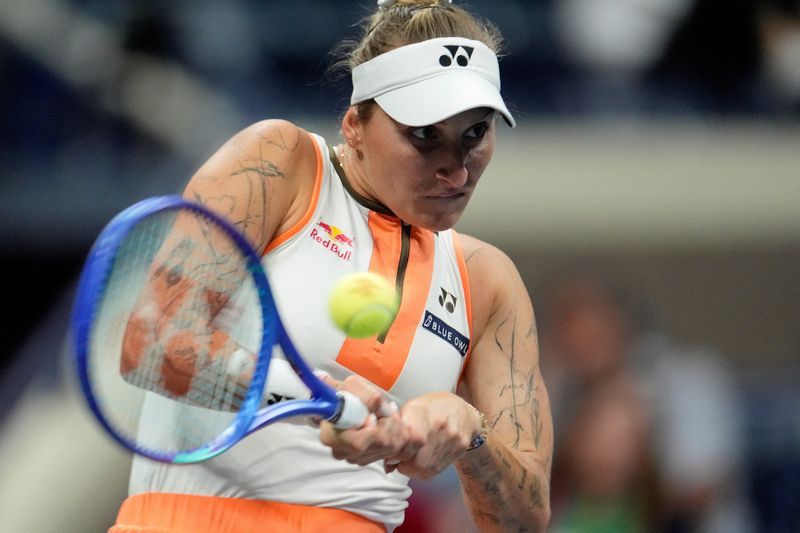
The tennis world finds itself grappling with fundamental questions about fairness and governance following the International Tennis Integrity Agency's decision to suspend Marketa Vondrousova for four years after she failed to provide a sample during an out-of-competition test at her home in December. The Czech player's punishment has become a flashpoint in an ongoing tension between protecting the integrity of professional tennis and safeguarding the rights and wellbeing of its athletes, particularly women competitors who face unique vulnerabilities during unannounced testing protocols.
Vondrousova's case carries particular weight because the former Wimbledon champion has never tested positive for prohibited substances, yet she now faces one of the sport's harshest penalties. The 26-year-old explained that she did not submit to testing when a doping control officer arrived at her residence at 8:15 p.m., describing the encounter as an invasive breach of her personal security and privacy. Her account resonates deeply within the professional circuit, especially following her public statement in April acknowledging that months of accumulated stress had left her psychologically fractured by the demands placed upon her.
The timing of this suspension compounds growing discontent within professional tennis ranks. The sport's anti-doping apparatus has faced mounting criticism for apparent inconsistencies in how it treats high-profile competitors. World number one Jannik Sinner received minimal sanction after testing positive in banned substances, as did Polish star Iga Swiatek, generating accusations that elite players benefit from more lenient treatment than their lower-ranked counterparts. These contrasting outcomes have deepened scepticism about whether the system operates with genuine impartiality or whether a player's commercial value and ranking influence enforcement decisions.
The Professional Tennis Players Association has seized upon Vondrousova's case to demand substantial structural reforms. In a pointed statement, the advocacy group emphasised that imposing a four-year ban on an athlete with no positive test history, particularly one who articulated reasonable safety concerns about an unidentified visitor arriving late at night, represents a disproportionate response that should compel the sport to reconsider its enforcement mechanisms. The PTPA has positioned its argument squarely around the principle that while testing itself merits defence, players must obtain genuine participatory power in formulating the regulations that govern them rather than accepting rules imposed unilaterally by governing bodies.
Women's safety during testing procedures has emerged as a central concern transcending the Vondrousova situation. The Czech player's reluctance to open her door to an unidentified person reflects genuine vulnerability shaped by trauma within her professional community. Petra Kvitova, her fellow countrywoman and accomplished competitor, endured a terrifying knife attack at her residential address in 2016, an incident that understandably conditions how female athletes respond to unexpected home visits. The intersection of anti-doping enforcement and personal safety thus creates a genuine dilemma that existing protocols appear inadequately equipped to navigate, particularly when test officials arrive during evening hours outside conventional business parameters.
The International Tennis Integrity Agency has defended its procedures and principles with considerable firmness. Karen Moorhouse, the ITIA's chief executive, maintains that unpredictable testing constitutes an indispensable mechanism for preserving competitive fairness across the sport, arguing that players must accept the inherent discomfort accompanying such protocols as the cost of competing professionally. She has highlighted that testing personnel undergo comprehensive training, carry official identification, and take precautions to protect both player and tester safety, including matching the gender of testing witnesses to players. Moorhouse's statement reflects the ITIA's conviction that rigorous, consistent enforcement protects the sport's credibility and ensures that all competitors operate under genuinely level circumstances.
However, the ITIA's confidence in its current framework faces legitimate challenge when testing procedures themselves create circumstances that could endanger the athletes they purport to protect. Requiring competitors to admit unidentified individuals to their homes during evening hours runs counter to fundamental personal security practices that women across all professions are routinely advised to follow. The regulatory dilemma here touches upon something deeper than procedural disagreement: it reflects a potential structural incompatibility between maximising testing unpredictability and ensuring player safety in ways that existing protocols have not adequately resolved.
Vondrousova's case also illuminates broader questions about how international sporting governance incorporates athlete voices into decision-making processes. Tennis operates under World Anti-Doping Agency frameworks established to create uniform standards across sports, yet this universalised approach may not account for sport-specific vulnerabilities or professional contexts. While alignment with global anti-doping standards carries obvious merit, the assumption that identical protocols serve all sports equally deserves scrutiny. Tennis's professional structure, where athletes spend significant time at residential addresses that may be publicly known, creates distinct testing circumstances compared to sports where athletes primarily compete at centralised venues.
The PTPA's filing of a formal lawsuit against tennis's governing bodies regarding privacy violations during testing represents a significant escalation beyond rhetorical criticism. This legal challenge suggests that athlete frustration has crossed into formal institutional channels, signalling that voluntary reforms may no longer suffice to address underlying concerns. Should courts ultimately rule in players' favour, the implications for tennis's anti-doping architecture could prove transformative, potentially forcing substantial modifications to testing protocols and establishing clearer boundaries around athlete privacy and personal security.
Vondrousova retains the opportunity to challenge her suspension through the Court of Arbitration for Sport, potentially offering an independent venue for reconsidering the ITIA's determination. The 2023 Wimbledon champion's ongoing shoulder injury, which has prevented her competitive participation since January, adds another dimension to her circumstances, as the four-year ban effectively eliminates her prime competitive years regardless of physical recovery. This convergence of injuries and disciplinary consequences creates a particularly sympathetic narrative that may influence how arbitration panels evaluate both the proportionality of her suspension and the adequacy of existing testing safeguards.
Several countervailing considerations complicate straightforward resolution of these competing interests. Anti-doping authorities maintain legitimate responsibility for ensuring that testing remains sufficiently unpredictable to prevent athletes from timing substance use around testing schedules. Simultaneously, tennis authorities must acknowledge that contemporary safety standards, professional norms around unsolicited home visits, and reasonable privacy expectations all argue for developing alternative testing methodologies that preserve competitive integrity without compromising athlete wellbeing. The path forward likely requires substantive negotiation between players, their representative bodies, and anti-doping authorities to establish protocols that accommodate both imperatives rather than treating them as irreconcilable opposites. Such dialogue need not undermine testing effectiveness; rather, it could enhance both compliance and confidence in anti-doping systems if athletes experience enforcement as fair, considerate, and genuinely protective of their safety and rights.

