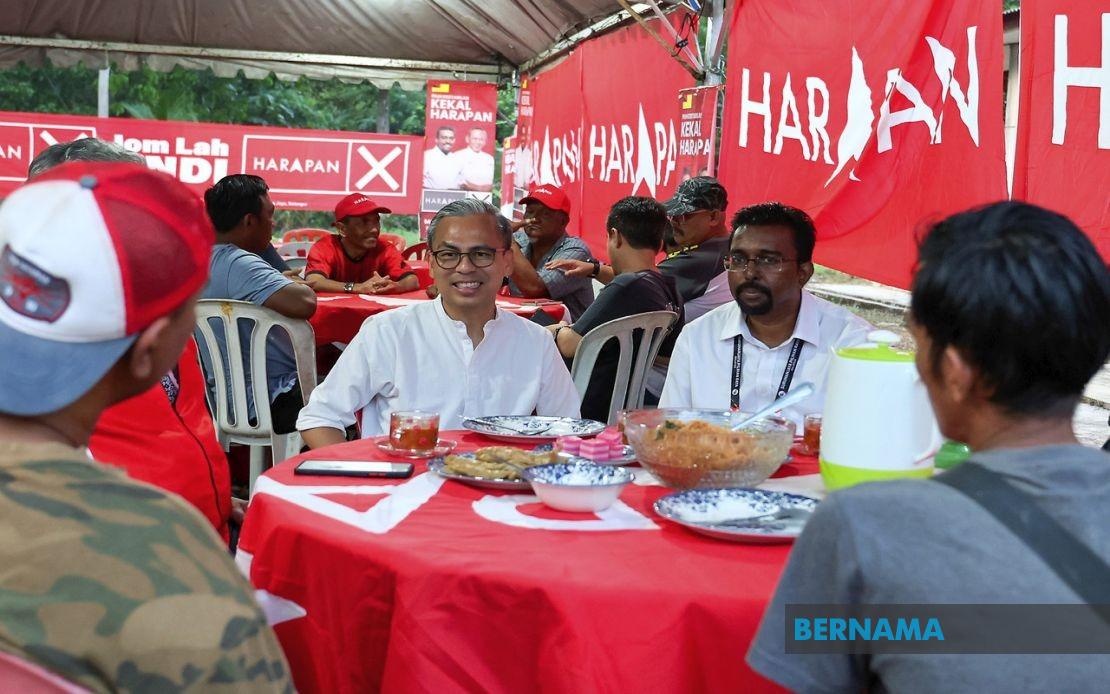
The outcome of any election ultimately rests with the electorate, not with political analysts or survey predictions, according to Pakatan Harapan Communications director Datuk Seri Fahmi Fadzil. Speaking at a community engagement event in Jempol on July 28, the PKR Information chief reframed recent electoral forecasts as motivation rather than cause for concern, positioning them as incentives for coalition candidates to intensify their campaign efforts on the ground.
Fahmi's remarks came in response to predictions made by former Bangi Member of Parliament Dr Ong Kian Ming regarding potential contest outcomes across multiple Negeri Sembilan constituencies. Rather than dismissing such analyses outright, Fahmi suggested that his party views such commentary as a call to action. He emphasised that Pakatan Harapan remains committed to direct voter engagement, particularly targeting undecided voters who could prove decisive in determining the composition of the state assembly.
The Communications Minister drew on his own political trajectory to illustrate the unpredictability of electoral outcomes. During the 14th General Election in 2018, virtually all pre-election surveys predicted his defeat in the Lembah Pantai parliamentary constituency. The actual result contradicted these projections entirely, with Fahmi securing victory despite unfavourable polling data. This experience, he suggested, underscores why quantitative predictions should never be treated as definitive forecasts of electoral behaviour.
Fahmi reported receiving encouraging feedback regarding voter sentiment in Negeri Sembilan, noting that support trends among swing voters appeared favourable for Pakatan Harapan. However, he cautioned that such positive indicators remained meaningless without actual electoral participation. The real measure of whether these encouraging signals translate into seats, he stressed, will be determined on voting day when citizens mark their ballots. This distinction between favourable conditions and actual electoral victory reflects the inherent unpredictability of democratic processes.
The PKR figure highlighted the tangible impact of state government programmes on constituent welfare, pointing to initiatives such as entrepreneurship incentives, financial assistance for newlyweds, and laptop distribution schemes for students. These practical measures, Fahmi suggested, have resonated with voters and demonstrate Pakatan Harapan's commitment to delivering concrete benefits beyond electoral rhetoric. The appreciation voters expressed for these schemes indicated genuine connection between government action and public satisfaction.
Beyond encouraging turnout and engagement, Fahmi issued a pointed warning about the spread of misinformation in the campaign's final stretch. He anticipated that unscrupulous actors would exploit the remaining days before the election to circulate false, misleading, or deceptively edited content across social media platforms, with WhatsApp emerging as a particularly problematic vector for spreading unreliable information. This final phase of campaigning, historically prone to rumour and sensationalism, demanded heightened public vigilance.
The Communications Minister provided specific examples of the types of misinformation circulating. Significantly, he referenced the circulation of archived video footage of Prime Minister Datuk Seri Anwar Ibrahim from his time as opposition leader, being reshared with the false implication that such remarks represented current positions or recent statements about Malaysia's armed forces. This instance exemplified how fragmentary content, historical footage, or partial quotations could be weaponised to create false impressions and undermine public trust.
Fahmi's concerns extended to the deliberate dissemination of half-truths and deceptively framed information designed to sow confusion and suspicion among the voting public. The recycling of outdated material presented as contemporary news constitutes a particular threat, as unsophisticated viewers may lack context to recognise the temporal manipulation. This phenomenon reflects broader challenges facing democratic societies navigating the intersection of social media, political campaigns, and information verification.
To counter this threat, Fahmi urged voters to employ critical evaluation standards when encountering campaign-related content online. He suggested that legitimacy could be assessed by cross-referencing claims against established mainstream media outlets including Berita Harian, TV3, RTM, Bernama, and Awani, as well as official government channels. Information not originating from or corroborated by these established sources should be treated with appropriate scepticism. This recommendation essentially encourages voters to rely on traditional gatekeeping mechanisms rather than unverified social media sharing.
The broader context of Fahmi's remarks reflects ongoing tensions within Malaysian politics regarding the reliability of electoral forecasting and the vulnerability of campaign discourse to manipulation. As digital platforms increasingly shape political communication, distinguishing between credible analysis and spurious prediction becomes crucial for informed voting. The 16th Negeri Sembilan state election thus represents another test case for how Malaysian voters navigate increasingly complex information environments during electoral contests.
Fahmi's emphasis on voter agency rather than predictive models carries particular significance for Southeast Asian democracies where polling methodologies remain underdeveloped compared to Western counterparts. Acknowledging this limitation indirectly reinforces the importance of on-the-ground campaigning and genuine voter contact rather than reliance on quantitative data. For Pakatan Harapan strategists, this framing conveniently emphasises the advantages of superior organisational capacity and grassroots mobilisation capabilities that surveys cannot adequately capture.
The election date itself—Saturday, the day Fahmi referenced—represented the culmination of weeks of intensified political activity across Negeri Sembilan's constituencies. The final three-day warning period before polling day historically witnesses escalated information warfare, as campaigns accelerate efforts to reach undecided voters while opponents deploy last-minute counter-messaging. Fahmi's preemptive alerting of the public to potential misinformation tactics represents standard communications practice, yet also reflects genuine concerns about social media's role in contemporary political contests.

