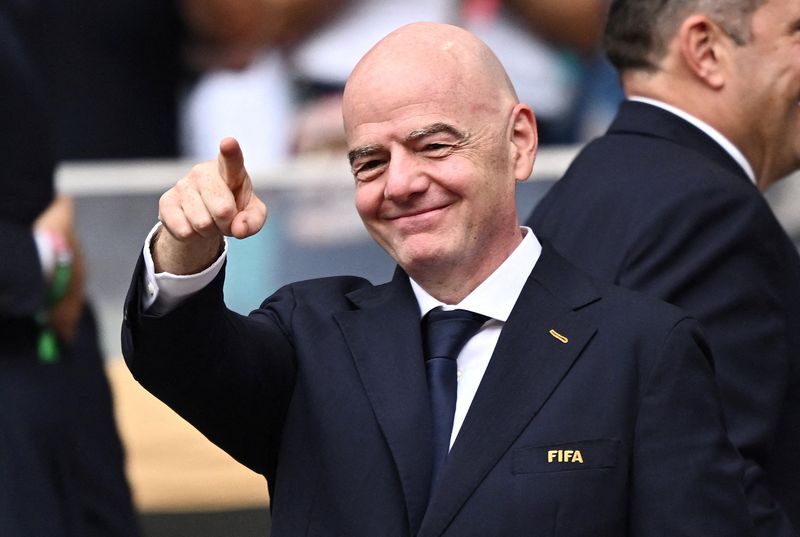
The Football Association of Wales has formally withdrawn its support for FIFA President Gianni Infantino's candidacy for the 2027-2031 term, marking the first formal rejection by a national federation following the dramatic collapse of FIFA's plan to privatise a significant portion of its most valuable asset. The Welsh decision comes in the wake of a failed initiative to unlock up to $4.2 billion in fresh capital by ceding approximately 20% ownership of a newly created entity that would have overseen major international competitions, including the men's World Cup.
FIFA's effort to attract private investment in its commercial infrastructure faced mounting resistance from key stakeholders, ultimately forcing the world football body to abandon the scheme on Friday. The reversal represents a significant setback for Infantino, whose leadership has come under unprecedented scrutiny following the proposal's collapse. The Welsh FA's statement left little ambiguity about its concerns, citing failures in governance standards, internal processes, transparency in decision-making, and stakeholder communication as primary reasons for withdrawing confidence in the FIFA president's continued stewardship.
Infantino has been central to FIFA's restructuring and modernisation efforts since replacing Sepp Blatter in 2016. Throughout his tenure, he has consolidated considerable authority over the international football body, winning re-election twice without facing opposition. His path to a fourth consecutive term had appeared straightforward until the privatisation proposal triggered fierce backlash from confederations and member federations worldwide. The scale of the failed initiative and the intensity of organised resistance suggest deeper fractures within FIFA's leadership structure than previously evident.
The rejection from Wales represents merely the opening salvo in what analysts expect will be sustained pressure on Infantino's presidency. UEFA, European football's governing confederation, spearheaded the opposition to the commercial rights plan and has now moved beyond public criticism to formal institutional action. The confederation sent a document preservation order to FIFA, a legal manoeuvre that prevents the destruction of emails, files, and electronic records in anticipation of potential investigation or litigation. While UEFA stopped short of publicly confirming reports that it was preparing formal legal proceedings against FIFA, the preservation order signals serious intent to pursue accountability for the failed initiative.
CONCACAF, which oversees football across North and Central America and the Caribbean, joined UEFA on Saturday in formally expressing lost confidence in Infantino's leadership. This dual rejection from two of FIFA's six regional confederations marks a dramatic shift in the political landscape surrounding the FIFA presidency. These confederations control significant voting blocs within FIFA's governance structure, and their explicit loss of confidence could substantially complicate Infantino's re-election prospects ahead of the March Congress scheduled to be held in Morocco.
The privatisation scheme itself represented an unusually ambitious restructuring of FIFA's financial model. Rather than relying primarily on tournament revenues, broadcasting rights, and sponsorships, FIFA sought to create a separate corporate entity that would capture future income streams from World Cup and other major competition broadcasting and commercial rights. This entity would have been partially owned by external investors, fundamentally altering the nature of FIFA's control over its most lucrative assets. The scale of proposed external investment—potentially exceeding $4.2 billion—underscored the financial pressures that had driven Infantino to pursue such a dramatic restructuring.
For Malaysian and Southeast Asian football stakeholders, the implications of this governance crisis extend beyond FIFA's internal politics. The governance failures and decision-making lapses that provoked Wales's withdrawal of confidence raise questions about FIFA's strategic direction and the stability of the international football system. Confederations within Asia, Africa, and other regions will be observing whether FIFA can restore confidence in its institutional processes before the March Congress vote. The upcoming presidential election will represent an opportunity for member federations to voice broader concerns about FIFA's governance standards and future direction.
The timing of this crisis carries particular significance as FIFA prepares for a crucial period of competition and infrastructure development. The World Cup privatisation plan, had it succeeded, would have locked FIFA's commercial interests with private capital partners for extended periods. The rejection of this initiative suggests FIFA membership remains cautious about surrendering control over the sport's most valuable properties, particularly to external investors with primarily financial rather than football-centred motivations.
Expertise within football governance circles suggests Infantino's path to re-election, while still mathematically probable, has become considerably more treacherous than appeared merely weeks earlier. Experts consulted by Reuters indicated that the opposition to the commercial rights proposal had exposed underlying dissatisfaction among FIFA members that could reshape the dynamics of the March Congress. Regional confederations and individual federations may use the presidential election as an opportunity to demand governance reforms, increased transparency, and greater stakeholder involvement in major strategic decisions.
The Welsh FA's decision to withdraw support represents more than a symbolic rebuke; it signals to other federations and confederations that questioning Infantino's presidency is now a politically viable position. Previously, his dominance over FIFA appeared virtually unchallenged, with re-election occurring without contests. The convergence of governance concerns, strategic missteps, and coordinated institutional resistance from major confederations has shifted that calculus fundamentally. As FIFA moves toward the Morocco Congress, the federation faces an increasingly complex political environment where Infantino's continued leadership is no longer presumptive.
The forthcoming weeks will likely bring additional statements from national federations and confederations regarding their positioning on the presidential election. The question now is not simply whether Infantino will be re-elected, but rather whether his re-election, should it occur, will provide him with the mandate and institutional trust necessary to effectively lead FIFA through upcoming tournaments and governance challenges. The collapse of the privatisation scheme and the resulting loss of confidence from multiple continental confederations have fundamentally altered the context within which FIFA's next presidential election will take place.

