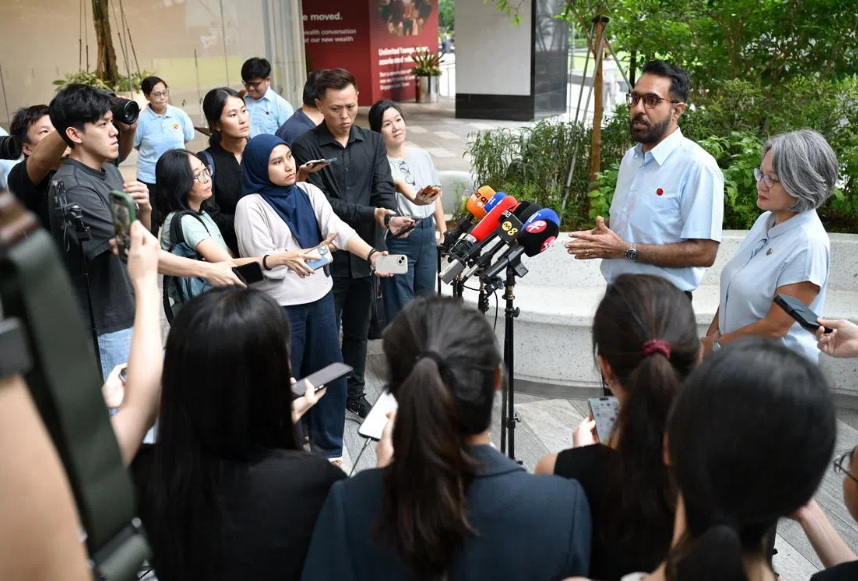
The Workers Party of Singapore has decisively moved past its most serious internal leadership crisis in years, with cadres voting to retain Pritam Singh as party chief by a substantial majority despite a formal challenge to his leadership. After nearly six hours of closed-door deliberations spanning two separate meetings on June 28, Singh emerged to address waiting journalists with evident confidence, declaring that the party had demonstrated its unity through the ballot. The outcome represents a crucial turning point for Singapore's main opposition force at a time when internal division could have proved catastrophic for its political prospects and credibility.
Singh faced the vote of no confidence after a group of disaffected party members moved to hold him accountable for his conviction on charges of lying to Parliament. The conviction itself stemmed from his role in a 2021 scandal involving former Sengkang GRC MP Raeesah Khan, who had fabricated an account of police mistreatment of a sexual assault victim during a parliamentary debate. When Khan later recanted her fabrication, the matter was referred to Parliament's Committee of Privileges, which determined that Singh had been complicit in prolonging her deception. A court subsequently found him guilty of dishonesty, and when he appealed, the High Court upheld the conviction in December 2025, affirming the judicial finding that he had misled Parliament.
The fallout extended beyond the courtroom. Parliament itself passed a motion declaring Singh unsuitable to remain as Leader of the Opposition given his conviction, prompting Prime Minister Lawrence Wong to formally remove him from that specific post. Throughout this tumultuous period, however, the Workers Party's establishment remained steadfastly loyal, declining to nominate an alternative MP for the Opposition leadership role despite being explicitly afforded that opportunity. A disciplinary panel within the party found that Singh had violated the party Constitution, yet the party's governing body chose to issue merely a formal letter of reprimand—a sanction that some observers characterized as relatively lenient given the gravity of the underlying conduct.
The cadre vote on June 28 reflected this institutional loyalty among the broader membership. Out of 106 cadre members present, 82 voted to retain Singh, representing a supermajority of approximately 77 percent. Singh himself abstained from voting, maintaining procedural propriety. Those opposed to his continued leadership had hoped that the special cadre conference would function as a genuine inquisition, providing a platform for rigorous questioning of his judgment and fitness to lead. Instead, party sources indicate that while Singh was indeed questioned, several speakers rose to defend him, suggesting that opposition within the party's activist base may be more muted than the leadership challenge initially implied.
Perhaps most significantly, the dissidents had actively sought to persuade an internal candidate to stand against Singh in the election, continuing these lobbying efforts right up until the week of the conferences themselves. Their inability to field a challenger speaks to Singh's institutional strength within the party and the absence of a clearly credible alternative leader who commands sufficient respect among cadre members. This vacuum of competing leadership talent underscores a critical vulnerability within the Workers Party as it contemplates long-term succession planning and organizational renewal. Party chair Sylvia Lim acknowledged this challenge explicitly at the post-election media session, noting that having served in her role for twenty-three years, leadership renewal represents a pressing organizational priority. She suggested that future media conferences might feature different party representatives, indicating that the current leadership does recognize the need for fresh faces to emerge.
The bloc of support for Singh has included some of the party's most venerable figures. Low Thia Khiang, who served as party chief before Singh and is widely recognized as the architect of the modern Workers Party, publicly affirmed his continued backing for the current leader. Low's endorsement carries substantial weight within party circles, given his historical stature and the respect he commands from long-serving activists. This intergenerational solidarity has effectively prevented the kind of public splits that have historically plagued other opposition movements, both within Singapore and across Southeast Asia. When opposition parties fracture along generational or factional lines, the damage to their public credibility and electoral prospects can prove severe and long-lasting.
With the internal leadership question now definitively resolved, the Workers Party can redirect its energies toward parliamentary activism and organizational growth. The conviction scandal had cast a shadow over the party's work in Parliament and its efforts to broaden its appeal beyond its traditional base. Singh's re-election removes a source of persistent distraction and allows the party apparatus to focus on substantive political messaging and constituency work. The party's recent growth trajectory provides some validation for this strategic reorientation; in the May 2025 general election, held when Singh had already been convicted in the lower court, the Workers Party not only retained all its existing constituencies but also secured two Non-Constituency MP seats, effectively expanding its parliamentary footprint.
Yet the episode also invites deeper scrutiny about the relationship between political pragmatism and ethical accountability within the opposition movement. When Singh was pressed about critics who characterize him as a "convicted liar," he deflected the question by directing people to his website, reasserting that his parliamentary position on the matter remained unchanged. This response arguably sidesteps rather than directly engages the moral dimension of the charge. For some observers, particularly those outside the Workers Party's supporter base, the party's decision to retain Singh despite his conviction suggests that institutional self-preservation may have outweighed principled reckoning with his conduct.
The Workers Party's relative immunity from the level of public scrutiny that the ruling People's Action Party faces may partly explain the cadres' willingness to move past the conviction issue relatively swiftly. As Singapore's primary opposition force but still a considerable underdog against the dominant PAP, the Workers Party operates within a media and political environment where it enjoys somewhat less intense public scrutiny. Many ordinary Workers Party supporters appear to view Singh's legal troubles primarily through a political rather than ethical lens, interpreting the conviction as a factional or prosecutorial matter rather than a fundamental character question. This partisan framing has enabled the party to maintain cohesion even as critical questions about honesty and accountability remain unresolved.
Looking forward, the Workers Party faces a complex challenge: it must consolidate its growing parliamentary presence and electoral support while simultaneously addressing the longer-term question of leadership succession and renewal. Singh's re-election with a strong majority provides him with the mandate and moral authority to govern the party for the immediate future. However, the very fact that no credible internal challenger could be identified, and that the party's formal disciplinary process resulted in a relatively mild sanction, suggests that the Workers Party may not yet have fully grappled with the lessons embedded in the Raeesah Khan affair and Singh's subsequent conviction. The party can now pivot to its substantive political work, but it does so having chosen institutional loyalty over a more searching examination of the principles and standards it claims to represent as an opposition movement.

