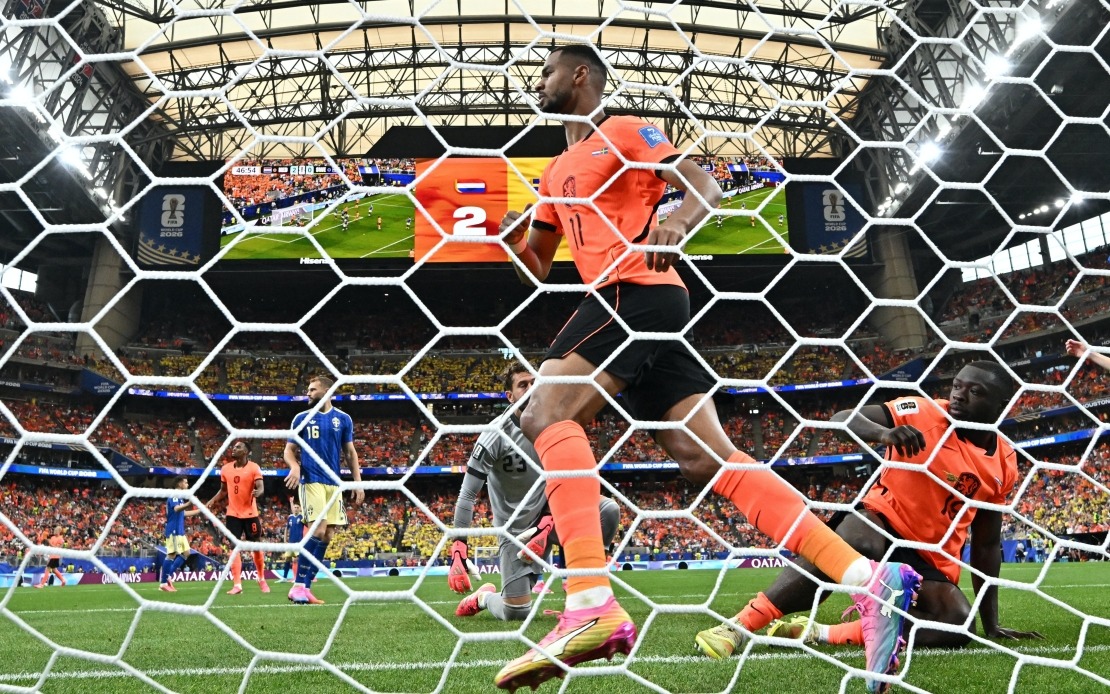
The 2022 World Cup has shattered historical scoring records, reaching the century mark in its 33rd fixture when Netherlands forward Cody Gakpo netted during a commanding 5-1 victory over Sweden. This milestone represents a remarkable acceleration in the tournament's goal-scoring pace, averaging 3.03 goals per match through this stage of competition. The speed at which this threshold was breached marks the fastest progression since Switzerland 1954, when 100 goals were recorded after just 20 matches—a comparison that underscores just how aggressive modern World Cup football has become compared to the intervening decades.
The historical context reveals a dramatic shift in tournament dynamics. Previous World Cups required significantly longer to accumulate 100 goals: Brazil 2014 and Spain 1982 both needed 36 matches, while Argentina 1978 and the United States 1994 each took 38 matches to reach the same milestone. The current tournament's trajectory suggests that if present-day scoring rates continue, the total number of goals across all fixtures could substantially exceed traditional World Cup averages, creating a tournament narrative centred on attacking football and wide-open competition.
Analysts have identified several interconnected factors driving this unprecedented scoring explosion. The official tournament ball, the Trionda, has come under particular scrutiny, with numerous observers suggesting its aerodynamic properties have fundamentally altered the dynamics of shot-taking. The ball appears to behave unpredictably on long-range attempts, potentially compromising goalkeepers' ability to read trajectories and position themselves effectively. This concern is underscored by the fact that ten goals have already been scored from outside the penalty area—a figure that would normally be distributed across an entire tournament rather than concentrated in the opening third.
Environmental conditions have also played a notable role in shaping match outcomes. The extreme heat in Qatar has visibly affected player performance levels, with fatigue accumulating throughout matches and contributing to lapses in defensive organisation. These physical demands have been compounded by the inclusion of mandatory three-minute cooling breaks, which paradoxically may have enhanced the attacking threat rather than simply providing respite. These breaks offer coaches critical opportunities to reorganise their tactical approach, make substitutions, and reset their team's shape—interventions that can tip the balance decisively in favour of attacking players seeking to capitalise on defensive transitions.
The tournament's structural expansion to 48 teams represents another significant departure from traditional World Cup formats. This enlargement has fundamentally altered qualification dynamics and match scheduling, potentially creating conditions where skill disparities between competing nations become more pronounced. Early results appeared to confirm predictions that the larger field would produce lopsided contests: Germany's devastating 7-1 dismantling of Curaçao, Canada's 6-0 thrashing of Qatar, and Tunisia's consecutive heavy defeats to Sweden and Japan seemed to validate concerns that expanding the tournament would simply produce a series of foregone conclusions.
However, the narrative around the expanded format has become considerably more nuanced as the tournament progressed. Numerous matches defied the anticipated pattern of dominant performances by established footballing powers. Curaçao managed to contain Ecuador in a goalless draw, demonstrating that emerging nations could mount credible defensive performances even against respected opposition. Cabo Verde held Spain to a scoreless stalemate, a result that would have seemed improbable based purely on historical pedigree and player quality differentials. Even Qatar, despite playing the majority of its Canada fixture with only nine players following a red card, competed fiercely rather than collapsing into capitulation.
The competitive resilience displayed by teams traditionally considered underdogs adds considerable weight to arguments that the expanded format has produced a more unpredictable and entertaining tournament. Jordan and Uzbekistan, despite losing 3-1 to Austria and Colombia respectively, demonstrated throughout their matches that they possessed sufficient tactical discipline and technical capability to remain genuinely competitive against superior opposition. These performances suggest that the additional teams brought into the tournament structure have brought with them improved tactical sophistication and professional standards, narrowing the traditional quality gap that has historically separated elite World Cup participants from emerging footballing nations.
For Malaysian football enthusiasts and regional readers, these developments carry important implications about the evolution of international football dynamics. The combination of environmental factors, equipment modifications, and structural tournament changes suggests that competitive football is entering a new paradigm where traditional power hierarchies may prove less decisive than previously assumed. Southeast Asian nations aspiring to future World Cup participation can draw encouragement from the demonstrated capacity of less-established teams to remain competitive and occasionally surprise better-favoured opponents.
The heightened scoring rate also reflects broader tactical evolution within professional football, where attacking systems and pressing strategies have increasingly dominated defensive conservatism. The willingness of teams to commit resources to offensive play, accepting greater defensive vulnerability in the process, mirrors trends visible in major European club competitions and suggests that defensive consolidation and cautious approaches have gradually lost favour among contemporary coaching philosophies. This tactical shift may offer particular insights for developing football regions seeking to identify competitive approaches suited to the modern international game.
Looking forward, the question of whether this scoring trajectory will be sustained throughout the tournament remains genuinely uncertain. Early tournament matches characterised by less-balanced competition may produce higher-scoring results than later stages, where eliminations concentrate the remaining teams around more evenly-matched groupings. Additionally, teams will have accumulated tactical intelligence and video analysis of opponents' approaches, potentially leading to more cautious and controlled matches as the competition progresses toward knockout phases. Nevertheless, the milestone achievement establishes clear evidence that contemporary World Cup football operates under fundamentally different competitive conditions than previous generations of the tournament.

