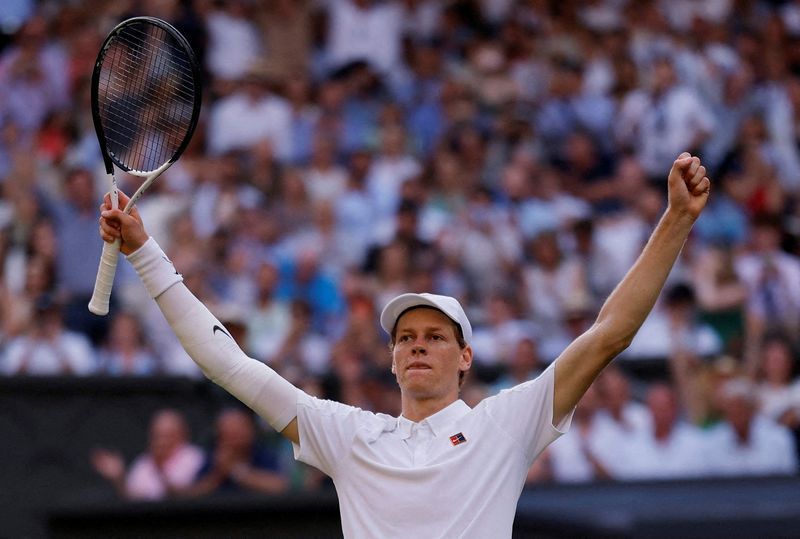
Jannik Sinner returns to the All England Club as defending Wimbledon champion, yet the mystique that surrounded the world number one has been significantly punctured. The Italian's arrival at the grass-court Grand Slam follows a stunning early exit from Roland Garros last month, a result that exposed vulnerabilities in his previously imperious form and raised uncomfortable questions about whether his dominance can withstand the rigours of major tournaments when physical demands peak. As Wimbledon begins on Monday, Sinner faces not merely the challenge of defending his title, but a more fundamental test: proving that the setback in Paris was an aberration rather than a symptom of deeper fragility.
Sinner's collapse at the French Open came after an extraordinary run that had seen him win 30 consecutive matches stretching back to February. That streak, built primarily on the red clay of Europe where his controlled game flourished, represented the kind of dominance that occasionally emerges in tennis before being tested at the sport's ultimate proving grounds. The Italian's second-round exit in Paris therefore carried particular weight, suggesting that the punishing schedule leading into Roland Garros had depleted his reserves precisely when he needed them most. His decision to skip warm-up tournaments ahead of Wimbledon, while potentially allowing recovery time, also means he arrives without competitive grass-court preparation—a tactical gamble that observers will scrutinise closely for any signs that confidence remains shaken.
Mats Wilander, the seven-times Grand Slam champion turned commentator, offered insight into the nature of Sinner's predicament. Speaking to La Gazzetta dello Sport, Wilander attributed the French Open collapse to accumulated fatigue rather than fundamental technical shortcomings, arguing that Sinner had been pushed to the limit by a relentless two-month calendar preceding Roland Garros, during which training opportunities were minimal. The Swedish legend suggested that rest would restore Sinner's competitive edge, yet he tempered this optimism with a pointed caveat: grass is inherently unpredictable, and the surface's peculiarities can punish even the world's finest players. This observation carries particular relevance for Sinner, whose game—precise, methodical, built on consistency and court positioning—must adapt to grass's reduced friction and emphasis on aggression and spontaneity.
The void left by Sinner's vulnerability has created space for rivals to harbour genuine title ambitions. Foremost among these is Novak Djokovic, the 39-year-old Serbian legend who remains grass's most accomplished practitioner still competing. Djokovic's movement and returning abilities transform him into a formidable proposition on the surface, where he last triumphed four years ago. Beyond mere title aspiration, Djokovic chases dual historical immortality: an eighth Wimbledon crown would match Roger Federer's record, while a 25th Grand Slam—a standalone major that would distance him from all rivals—remains his white whale. For a player approaching the twilight of an extraordinary career, this represents perhaps his final realistic opportunity to cement both legacies simultaneously.
Djokovic's own French Open early exit, mirroring Sinner's stumble, might ordinarily suggest diminished prospects. Yet Andy Roddick, the American former finalist who now commentates on the sport, identified a crucial psychological difference. Speaking on his podcast, Roddick suggested that Djokovic, far from being discouraged by Paris, likely views Wimbledon as his genuine opportunity. The Serb possesses sufficient self-knowledge and experience to recognise that grass presents his strongest remaining avenue to major success, and Roddick argued that Djokovic will have constructed a compelling narrative within his own mind that this is the moment to strike. The American's commentary reflected tennis's age-old dynamic: momentum and form matter, yet Wimbledon's particular characteristics can favour unlikely victors who possess the right skill set and mental fortitude.
Alexander Zverev, the German who dramatically captured his first Grand Slam at Roland Garros weeks earlier, enters Wimbledon riding the unprecedented confidence that comes with silencing doubters after years of near-misses. His French Open triumph at age 29 represented vindication of a career that, despite ranking highly and accumulating Masters 1000 titles, had been shadowed by Grand Slam disappointment. Zverev's powerful serve—repeatedly identified as the cornerstone asset on grass—combined with his reach and athleticism, theoretically positions him well for success on a surface where, as the saying goes, a dominant serve can carry a player to semi-finals almost by itself. Boris Becker, Zverev's fellow German and a player who won Wimbledon twice, provided striking validation, telling Eurosport that Zverev has become the legitimate favourite in the wake of Alcaraz's absence and Sinner's uncertainty.
The injury to Carlos Alcaraz cannot be understated in its impact on the tournament's narrative. The Spanish sensation won Wimbledon in both 2023 and 2024, establishing himself as the most dominant grass-court player of the contemporary era and representing the closest thing modern tennis possesses to an invulnerable force on the surface. His absence removes not only a formidable competitor but also forces a recalibration of expectations: instead of a narrow title race between two or three titans, the draw has widened considerably, creating space for a broader cohort of challengers to entertain genuine aspirations. This expansion of possibility, while generating uncertainty, also presents an opportunity for players who might otherwise languish in the shadow of Alcaraz's dominance.
Beyond the established names, a secondary tier of American and Italian players threatens to disrupt the narrative. Ben Shelton, Taylor Fritz, and Frances Tiafoe all possess the serving power and aggressive groundstroke weapons that grass rewards, while each has demonstrated against top-ranked opposition that they belong in elevated company. Flavio Cobolli, the Italian who reached Roland Garros's final as a surprise package, represents the next generation eager to announce itself on grass. For Malaysian and Southeast Asian readers, the widening of Wimbledon's genuine contender list demonstrates how injuries and unexpected collapses can fundamentally alter the mathematics of major tournaments, creating openings for players previously considered fringe threats.
The broader context is significant for regional tennis development. Wimbledon typically narrows to focus on established superstars, yet this year's circumstances suggest that depth and versatility matter as much as individual excellence. Sinner's vulnerability, despite being ranked first, illustrates that sustained dominance remains fragile in professional tennis—a reminder that consistency requires not merely talent but injury-free progression, fortunate draws, and the ability to maintain physical and mental resources across months of relentless competition. For emerging Southeast Asian players, the lesson is twofold: the grass-court game remains specialised and difficult, yet opportunity occasionally emerges when the established order fractures.
Sinner's path forward requires not merely defending his title but establishing that his clay-court excellence translates convincingly to grass. The Italian has trained specifically for this reset, and his technical gifts—particularly his precise serve and ability to construct points methodically—should theoretically serve him well. However, Wimbledon grass in its current, faster iteration rewards aggression and power more generously than the surface's historical norms, potentially disadvantaging players whose methodology emphasises accuracy over intensity. Sinner's preparation will be scrutinised constantly; any early-round struggles, even against modest opposition, would fuel narrative of lasting damage from Paris, while commanding early victories would signal that the defending champion has indeed reset and remains the man to beat despite the aura now surrounding his rivals.

