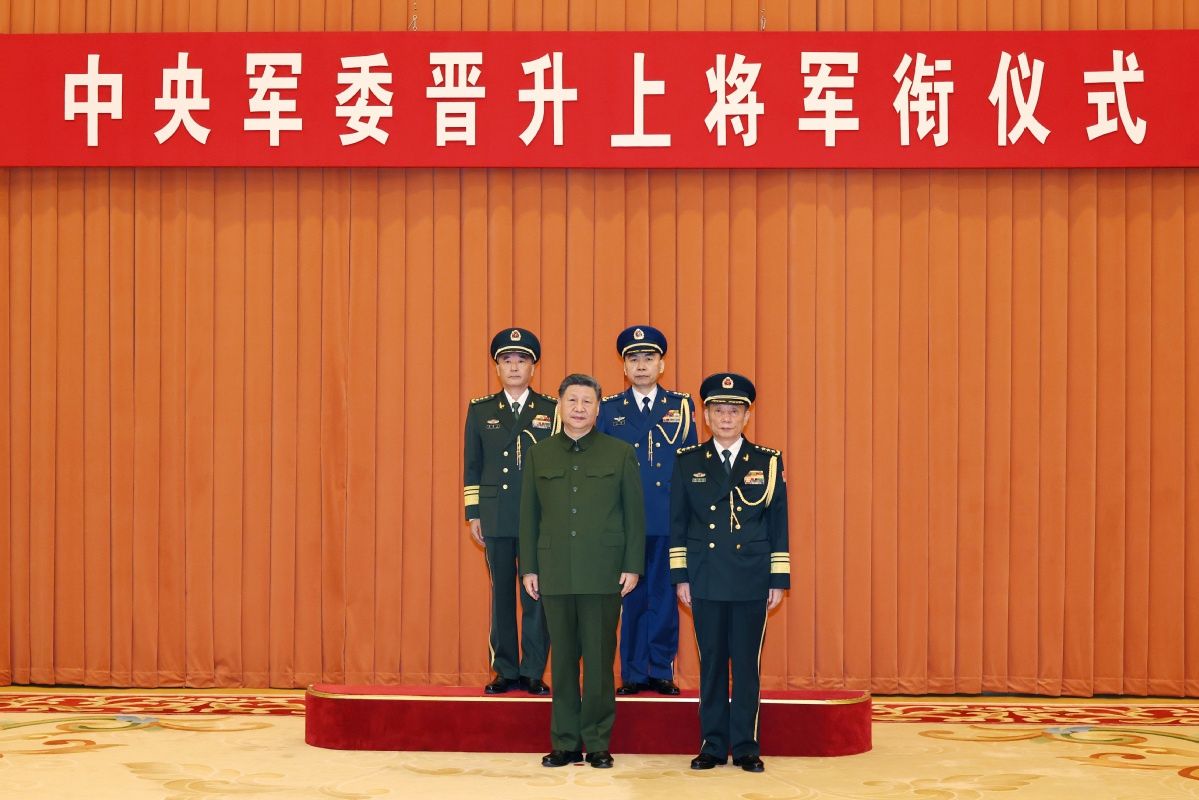
Chinese President Xi Jinping is tightening his grip on the military establishment through a comprehensive overhaul of key defence positions, appointing Zhang Shuguang to lead anti-corruption efforts within the armed forces. The appointment, announced Friday through state media following a ceremony in Beijing presided over by Xi himself, underscores the president's determination to reshape military governance as he consolidates power ahead of crucial policy decisions affecting the region. This reshuffle represents the latest chapter in an extraordinary campaign of military restructuring unprecedented in scale since the Cultural Revolution era.
Zhang Shuguang now heads the Central Military Commission's discipline inspection commission, the institutional hub for rooting out graft and misconduct across the People's Liberation Army. Simultaneously, Wang Gang has assumed command of the PLA Air Force, one of the most strategically significant positions within China's military apparatus. Both men received promotions to the rank of general, China's apex rank for serving officers, signalling their elevated status within the command hierarchy. The parallel advancement of multiple senior figures suggests Xi is methodically installing trusted lieutenants in positions where loyalty and ideological alignment matter most.
The shuffle saw Zhang Shengmin, who previously anchored the military's corruption investigation machinery as the top anti-graft official, elevated to vice chairman of the Central Military Commission—a lateral move that nonetheless repositions him in the upper echelon of defence decision-making. Former Air Force Commander Chang Dingqiu's next assignment remains publicly undisclosed, though the lack of clarity itself carries significance in Chinese political contexts, where unexplained departures from high-profile roles often indicate disfavour or investigation. These moves collectively demonstrate Xi's preference for regularly rotating senior military personnel to prevent the consolidation of independent power bases.
The broader campaign driving these personnel shifts commenced in mid-2023, months after Xi secured an unprecedented third term as party chairman—a development that shattered decades of precedent regarding leadership succession in the Chinese Communist Party. The timing reveals Xi's strategic approach: consolidate political authority first through party channels, then methodically reshape the military institution that ultimately answers to party control. Over the past eighteen months, this purge has claimed two vice chairmen of the Central Military Commission, three sitting CMC members, a former defence minister, and at least a dozen high-ranking generals commanding significant military regions or service branches.
Perhaps the most dramatic manifestation of Xi's military housecleaning unfolded earlier this year when investigators examined General Zhang Youxia, once considered Xi's closest military ally and a confidant from their shared experiences in Fujian Province decades earlier. The investigation of Zhang Youxia shocked observers precisely because it demonstrated that even the deepest personal relationships offer no immunity from the president's anti-corruption apparatus. The inclusion of such a trusted figure signals that institutional loyalty to Xi's vision supersedes personal history, fundamentally reshaping how senior military figures calculate their survival strategies.
The military purge occurs within a distinctly Chinese institutional context that differs markedly from democratic militaries overseen by civilian governments. The People's Liberation Army answers directly to the Communist Party rather than to constitutional civilian authority, and within that framework, the CMC serves as the paramount decision-making body controlling military operations, appointments, and strategic planning. By inserting loyalists throughout this apparatus, Xi ensures that military infrastructure aligns with his political agenda and personal vision of China's future development trajectory. The anti-corruption justification, while containing genuine cases of misconduct, simultaneously serves as the rhetorical framework for eliminating potential rivals and consolidating centralised command.
For Southeast Asian nations, including Malaysia, these military restructurings carry substantial implications for regional security calculations. China's military is the single most consequential armed force shaping regional balance, and the extent to which its leadership operates cohesively under Xi's direction directly influences Beijing's approach to maritime disputes, military modernisation, and strategic assertiveness. A military led by Xi's handpicked loyalists may behave more predictably in advancing his geopolitical vision but also potentially more aggressively if Xi perceives opportunities to expand Chinese influence or resolve outstanding territorial claims through military means. Regional defence establishments monitor these shifts closely to anticipate possible changes in Beijing's strategic posture.
The recent decision to strip six military lawmakers of their parliamentary seats further illustrates the comprehensive nature of Xi's military consolidation. These individuals, previously selected to represent defence interests within the National People's Congress, evidently fell short of Xi's expectations for political reliability or ideological conformity. Their removal from legislative positions signals that Xi is constructing a completely integrated civil-military governance structure where military leaders active in national legislative processes must demonstrate unambiguous loyalty to the president's strategic preferences. This integration contrasts with democratic models where civil-military separation serves as a check against authoritarian drift.
The appointment sequence also reflects Xi's sensitivity to succession planning and institutional memory within the military elite. By promoting multiple officials simultaneously and reshuffling their portfolios, Xi avoids allowing any single individual to accumulate excessive influence across multiple command areas. This rotation strategy prevents the emergence of potential succession rivals within the officer corps and forces senior military figures to focus on their immediate assignments rather than cultivating independent political constituencies. Zhang Shuguang's appointment to the discipline commission is particularly significant because that position provides access to comprehensive intelligence about vulnerabilities within the officer corps—intelligence that could prove decisive in future power struggles.
China's military modernisation, already historically rapid, continues accelerating across air, naval, and missile capabilities. The coordination between an increasingly centralised political leadership and a military structure stripped of independent fiefdoms could theoretically enable more rapid implementation of strategic initiatives. However, it simultaneously eliminates the friction and competing institutional viewpoints that sometimes moderates authoritarian decision-making. For the region, a military perfectly aligned with Xi's preferences represents both increased predictability regarding institutional alignment and potentially decreased predictability regarding Xi's personal strategic choices, particularly if he perceives windows of opportunity for territorial advancement or regional repositioning.
Analysts expect continued personnel churn within the military establishment as Xi's consolidation project continues, with the anti-corruption mandate providing indefinite justification for removing officers deemed insufficiently reliable. The precedent of investigating Zhang Youxia demonstrates that historical relationships and demonstrated loyalty cannot guarantee protection, creating pervasive uncertainty among senior commanders about their ultimate political fate. This atmosphere of institutional insecurity could paradoxically strengthen Xi's personal authority even as it potentially undermines the military's internal cohesion and institutional depth. The next several years will reveal whether this aggressive centralisation enhances or ultimately constrains China's military effectiveness.

