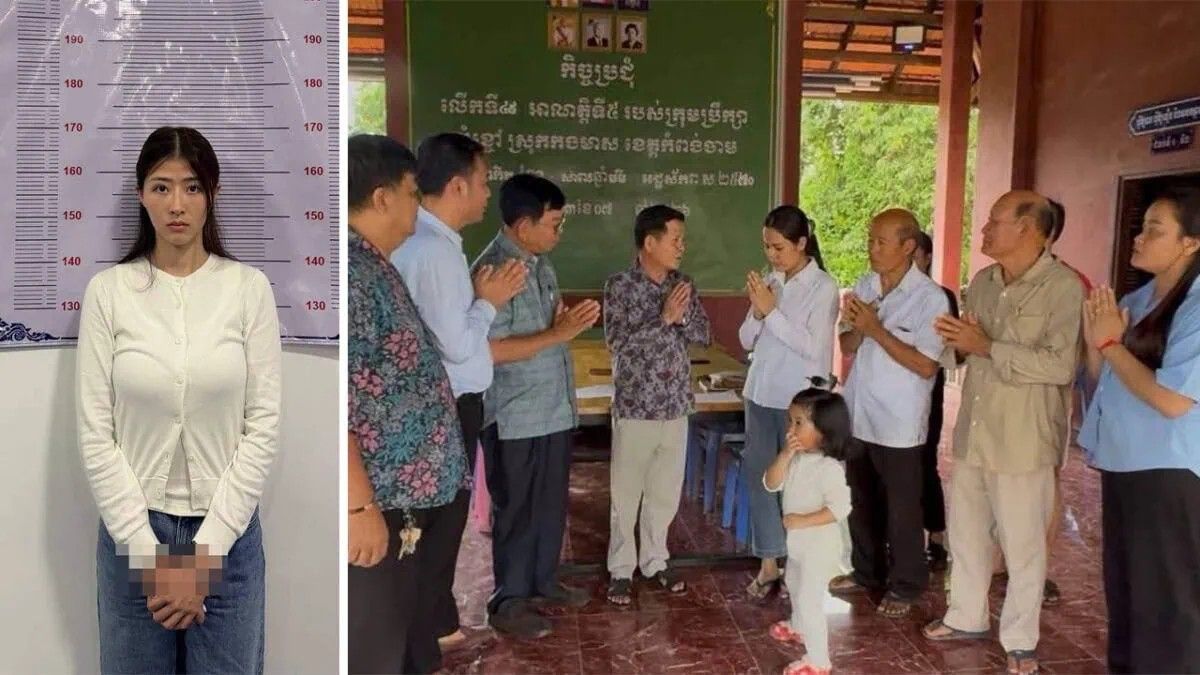
The family of Kuoch Limhan, a Ministry of Public Works and Transport official fatally struck by a vehicle in Phnom Penh last month, has resolved its civil dispute with the accused driver's family through an out-of-court settlement worth S$60,000, though criminal proceedings will press ahead against the suspect, Sam Meychou. The two parties formalised the agreement on August 6, with both families and their legal representatives signing an accord aimed at closing the civil dimensions of the case through mutual compensation and understanding.
Oknha Tong Hok Seng, the father of Meychou, provided the S$60,000 in damages to Limhan's widow as part of the settlement framework. Seung Kimhor, acting as the victim's family representative, joined the agreement as a signatory alongside the defendant's father. The settlement was witnessed by Kong Sekleng, the local commune chief, and lawyer Phon Thearin, lending official weight to what both parties described as an amicable resolution of their differences. The arrangement explicitly bars either side from lodging fresh claims or pursuing additional demands, with both families declaring the matter settled through goodwill and mutual accord.
The civil withdrawal, however, represents only one layer of the legal proceedings unfolding in Phnom Penh. While the victim's family has chosen not to pursue further compensation through the courts, the criminal investigation against Meychou continues independently. The Phnom Penh Municipal Court maintains its prosecution of criminal case No. 4396, originally filed on July 31, 2026, ensuring that questions of criminal liability and potential punishment remain entirely separate from the settled civil claim. This distinction underscores a pattern common in Southeast Asian justice systems, where civil remedies and criminal accountability operate in parallel tracks, each subject to different standards and outcomes.
Limhan, a construction laboratory official, was returning home on his motorcycle during the evening of July 28 when Meychou's vehicle collided with him in Sen Sok district. According to witness accounts and police reconstruction of the incident, Meychou had crossed the centreline while attempting to overtake another vehicle, striking Limhan's motorcycle with fatal force. The victim, who was carrying milk for his young daughter, died instantly at the scene. Security footage from the collision site captured Meychou and an associate departing in a tuk tuk, leaving Limhan's body lying on the rain-soaked pavement amid the chaos of the immediate aftermath.
Meychou presented herself to authorities on July 30, the afternoon following the collision, and underwent questioning by police and investigating officers. On July 31, the municipal court formally charged her with causing a fatal traffic accident and absconding from the scene—charges that carry serious criminal penalties under Cambodian traffic and penal law. The investigating judge, after reviewing evidence and conducting preliminary interrogations, ordered her detention pending trial, indicating the prosecution's assessment that sufficient grounds existed to proceed with formal charges and that she presented risks warranting pre-trial custody.
The criminal case now moves through Cambodia's court system independent of the financial settlement between families. The prosecution must prove beyond reasonable doubt that Meychou's actions constituted negligence resulting in death and that she deliberately fled the scene, both elements requiring substantial evidentiary presentation. The separation of civil compensation from criminal prosecution reflects international standards in traffic fatality cases, where compensating the victim's family does not extinguish the state's interest in holding offenders accountable for breaches of criminal law. This approach prevents wealthy defendants from simply purchasing their way out of criminal responsibility, though it does mean victims' families can pursue settlements without waiting for criminal verdicts.
The settlement itself carries symbolic weight within Cambodian legal culture and community norms. Out-of-court agreements in traffic fatality cases have become increasingly common across Southeast Asia as families weigh the extended duration of criminal trials against the certainty of immediate financial relief. The involvement of local commune officials and private legal counsel in witnessing the agreement reflects the hybrid approach to dispute resolution that characterises Cambodian practice, blending formal legal procedures with community-level mediation principles. The S$60,000 figure, while substantial, reflects both the economic circumstances of the defendant's family and prevailing valuations of life and suffering within Phnom Penh's socioeconomic context.
For Malaysian observers, the case illustrates how neighbouring jurisdictions handle traffic fatalities and offers comparative insights into civil settlement practices. Malaysian courts and families similarly navigate the relationship between compensation claims and criminal prosecutions, though the specifics of law and procedure differ markedly. The case also highlights the vulnerability of motorcycle users across Southeast Asian cities, where two-wheeled vehicles represent the predominant transport mode for working families yet remain disproportionately exposed to collision risk from larger vehicles. Limhan's death—a routine journey disrupted by another driver's overtaking manoeuvre—exemplifies the everyday hazards that plague the region's increasingly congested streets.
The criminal proceedings advancing against Meychou will now focus on establishing negligence, examining vehicle maintenance records, road conditions, and visibility factors that may have contributed to her decision to overtake. The prosecution will likely present the security footage and witness testimony regarding her departure from the scene as evidence of consciousness of guilt, a factor that courts across the region view seriously in traffic fatality cases. Defence counsel may argue for reduced culpability based on road conditions, mechanical failure, or visibility limitations, though the centreline crossing during overtaking presents substantial evidentiary obstacles to mounting a credible denial of primary fault.
The timeline of events—collision on July 28, surrender on July 30, formal charging on July 31, and civil settlement by August 6—reflects the relatively swift pace at which Cambodian authorities processed this case, likely accelerated by its involving a government official and generating public attention. The efficiency contrasts with protracted proceedings common in other regional jurisdictions where traffic fatalities can languish in courts for years before resolution. Whether Meychou's cooperation and the family's civil settlement will influence the eventual criminal sentence remains uncertain, though such factors sometimes feature in sentencing considerations across Asian legal systems.

