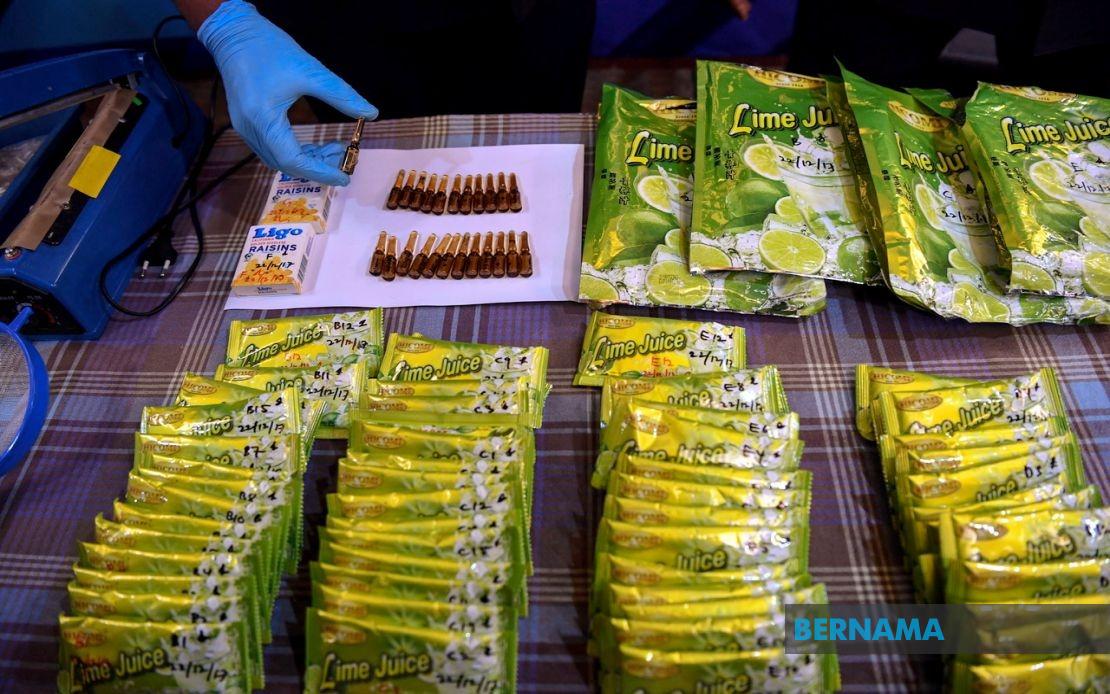
Malaysia's war on synthetic drugs is entering a critical new phase, with the Home Ministry deploying sophisticated technology and preparing sweeping legislative changes to address what officials describe as an alarming surge in trafficking and consumption of highly addictive compounds. Home Minister Datuk Seri Saifuddin Nasution Ismail has flagged the escalating menace posed by methamphetamine, designer pills commonly called "piu-piu," and illicit fentanyl formulations that have recently infiltrated local markets, characterising these substances as driving unprecedented rates of overdose deaths and fuelling interconnected waves of organised crime and social dysfunction across the nation.
The scale of the problem has become starkly evident in official enforcement statistics. Between 2023 and June 2026, police forces nationwide logged 238,704 arrests linked to synthetic drug offences, a volume that underscores the pervasiveness of the issue across both urban and remote communities. This arrest rate reflects not merely the activities of traffickers but also the growing user base, suggesting that synthetic drugs have moved beyond niche markets into mainstream consumption patterns among Malaysian populations. The ministry's disclosure comes amid parliamentary scrutiny from elected representatives concerned about drug proliferation in regions like Sarawak, where geographical isolation and porous borders have historically complicated law enforcement operations.
Responding to parliamentary questions about conditions in Sarawak specifically, the minister provided granular data revealing that in the first half of 2026 alone, local authorities detained 7,097 individuals on drug-related charges. This figure breaks down into 342 professional traffickers, 1,314 people apprehended for possession, and 5,441 classified as drug users undergoing arrest. Such distinctions matter considerably for understanding enforcement priorities and the demographic spread of addiction, suggesting that supply-side operations remain a focus even as demand-reduction strategies target end-users. Simultaneously, law enforcement agencies seized 418.01 kilogrammes of drugs valued at RM53.73 million during the same period, with supplementary actions against financial assets generating RM1.95 million in confiscated syndicate holdings.
Operations have intensified significantly through coordinated campaigns named Op Tapis and Op Tapis Khas, deployed across diverse terrain encompassing densely populated cities, agricultural regions, and sparsely populated frontier zones. These operations represent institutional collaboration between the Royal Malaysia Police, the National Anti-Drugs Agency, and the Royal Malaysian Customs Department, pooling intelligence and resources across traditional jurisdictional boundaries. The strategic scope encompasses both detection and interdiction functions, recognising that synthetic drug networks operate across multiple stages from international smuggling through domestic distribution to street-level retail. Such comprehensive approaches have become necessary because synthetic drugs, unlike traditional narcotics, often change chemical composition to evade scheduling restrictions, requiring flexible enforcement architectures.
Technological modernisation forms a cornerstone of enforcement strategy going forward. The ministry confirmed that police operations increasingly incorporate drones for aerial surveillance and reconnaissance, enabling officers to monitor high-risk zones and track suspicious movement patterns with minimal human presence. Fixed surveillance camera networks provide persistent monitoring capabilities in strategic locations, with imagery fed into analytical systems that can identify anomalies and suspicious activities automatically. These technological investments represent significant departmental spending, but officials argue they deliver multiplicative returns by extending enforcement reach into areas previously difficult to monitor effectively. The integration of modern technology into police operations also reflects broader recognition that nineteenth-century drug enforcement methods prove inadequate against twenty-first century criminal networks employing encrypted communications and sophisticated distribution logistics.
Beyond operational enforcement, the ministry is pursuing institutional reforms to close legal loopholes that have enabled traffickers to market novel synthetic substances before regulatory authorities could formally prohibit them. The government is actively considering amendments to the Dangerous Drugs Act 1952 that would expand scheduling mechanisms to capture emerging designer drugs and novel psychoactive substances under existing legislative frameworks. This represents a significant policy evolution, as traditional approaches listed specific chemical compounds, meaning chemists could synthesise structural variants that technically fell outside existing prohibitions. New legislative language would presumably provide regulatory authorities discretionary power to prohibit substance classes based on chemical structure and pharmacological effects, rather than requiring exhaustive enumeration of every possible molecular permutation. Such framework amendments typically require extensive parliamentary procedure and stakeholder consultation, but the ministry's public commitment suggests this reform enjoys cross-party support within government.
Forensic laboratory capacity building accompanies legislative reform efforts, with the ministry noting continuous enhancements to analytical capabilities for profiling emerging synthetic trends and identifying fentanyl analogues and synthetic opioids. These laboratory improvements matter considerably because synthetic drugs often arrive in formulations containing multiple psychoactive components, requiring sophisticated chemical analysis to identify constituents accurately. Enhanced capabilities enable faster detection timelines, permitting enforcement agencies to respond more rapidly to novel drug variants appearing in local markets. The forensic emphasis also supports prosecution functions, as rigorous chemical identification provides evidential foundation for judicial proceedings against traffickers. This infrastructure investment signals that officials recognise synthetic drug enforcement as requiring sustained commitment extending across decades.
Drug prevention programming complements enforcement and legal reform initiatives, reflecting the ministry's understanding that supply-side interventions alone cannot reverse addiction epidemics without corresponding demand reduction. Between 2023 and June 2026, authorities conducted 1,144 prevention programmes nationwide aimed at building public awareness about synthetic drug dangers. These programmes typically target school-age populations, community leaders, and vulnerable groups, attempting to instil understanding about addiction mechanisms and health consequences before exposure to drugs occurs. Prevention messaging emphasises the particular lethality of fentanyl analogues, which can prove fatal in microscopic quantities, and the rapid addiction pathways created by methamphetamine's neurochemical effects. Such initiatives operate through partnership with civil society organisations, educational institutions, and religious bodies, leveraging trusted community voices to amplify health messaging beyond what government agencies alone can achieve.
The specific challenges presented by rural and remote regions like Sarawak merit particular attention within this enforcement framework. Geographic isolation and dense forest terrain create law enforcement difficulties, as trafficking networks exploit inadequate surveillance and limited police presence to establish operations beyond effective oversight. Sarawak's longer international land borders with Brunei and Indonesia potentially facilitate cross-border drug smuggling, with supply chains leveraging jurisdictional complexities to evade sustained pursuit. The thirteen individuals detained under the Dangerous Drugs (Special Preventive Measures) Act 1985 during the first half of 2026 in Sarawak reflect authorities' application of preventive detention authority targeting individuals deemed high-risk for trafficking recidivism. Additionally, 131 hardcore drug addicts faced compulsory action under treatment provisions, representing government attempts to interrupt addiction cycles through forced rehabilitation frameworks.
The emergence of synthetic drugs represents a qualitative shift in Malaysia's drug threat landscape, distinguishing current challenges from historical heroin epidemics or cannabis prevalence. Synthetic substances typically prove more profitable for traffickers due to smaller physical volumes producing potent effects, creating incentive structures favouring international smuggling over domestic cultivation. Fentanyl particularly concerns authorities because pharmaceutical legitimate production provides cover for diversion operations, and because its potency means tiny measurement errors can precipitate fatal overdoses. The "piu-piu" pills represent manufactured designer drugs optimised for recreational appeal and addiction potential, with manufacturers continuously altering formulations to maintain legal grey areas. Methamphetamine production, whether locally or regionally sourced, feeds addiction patterns among younger populations and links to violence and property crime networks seeking to fund consumption habits.
The enforcement intensity reflected in 238,704 arrests over three years demonstrates government commitment, yet such volume also underscores the challenge magnitude. Arrest rates cannot meaningfully reduce drug problems without addressing underlying factors driving supply and demand—poverty and limited economic opportunity in source regions, social alienation among vulnerable youth populations, inadequate mental health services, and international drug trafficking profitability. Malaysia's experience reflects regional patterns affecting Southeast Asia broadly, where synthetic drug networks operate across permeable borders exploiting geographic proximity and developmental disparities. Successful long-term drug control requires sustained commitment to enforcement technology, legislative modernisation, and prevention investment alongside regional cooperation to disrupt international trafficking networks. The ministry's multi-pronged approach indicates recognition of these complexities, though measuring actual effectiveness will require monitoring whether arrest rates and seizure volumes translate into reduced availability and declining addiction incidence among target populations.

