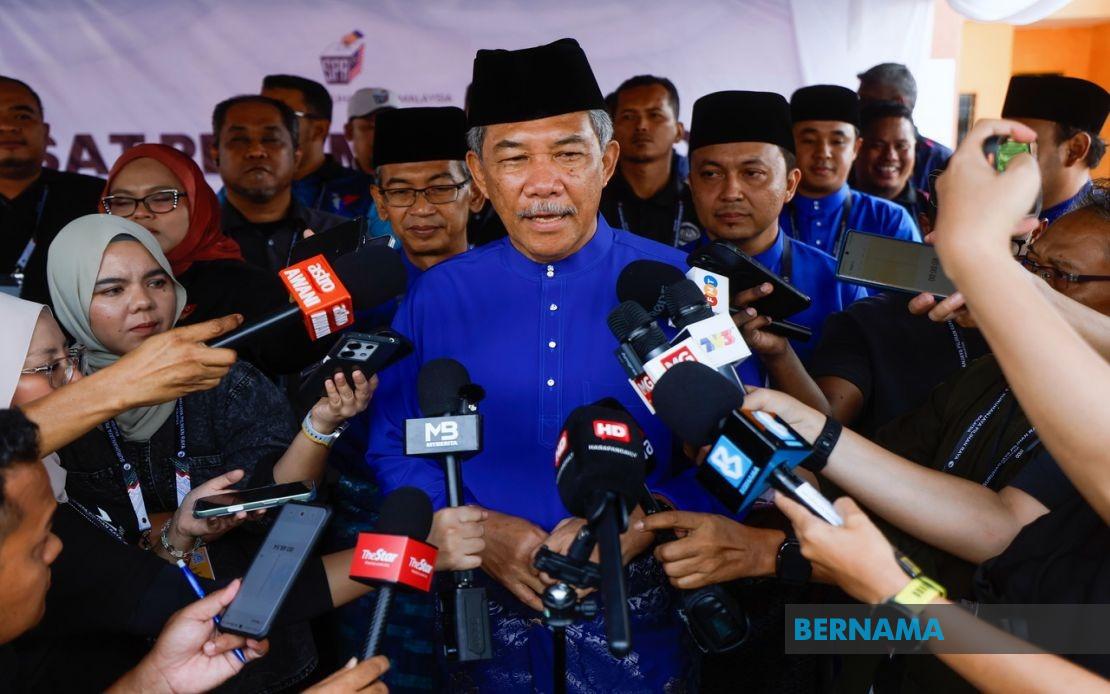
Barisan Nasional's second-ranking leader, Datuk Seri Mohamad Hasan, has issued a stern warning to party campaigners in Negeri Sembilan to steer clear of the state's adat traditions as electoral fodder, marking a calculated effort to insulate cultural institutions from partisan contestation. Speaking in Rembau following the nomination process for the 16th Negeri Sembilan state election, the UMNO deputy president articulated a boundary between politics and tradition that he believes must be maintained to uphold social cohesion during competitive polling periods.
The concern raised by Mohamad reflects broader sensitivities in Negeri Sembilan, a state where adat institutions—rooted in customary Minangkabau heritage—retain significant cultural and symbolic authority. By explicitly prohibiting his party machinery from leveraging these customs as campaign material, Mohamad seeks to prevent the kind of polarization that often emerges when deeply held cultural practices become entangled with partisan messaging. His statement suggests that party strategists had identified this as a potential vulnerability or temptation during the campaign cycle.
The caution against mingling adat affairs with electoral politics carries particular weight given Malaysia's constitutional and institutional framework, which accords special standing to indigenous practices in certain states. Negeri Sembilan's matrilineal adat system, which governs property inheritance and social hierarchy, remains integral to community identity. When politicians attempt to mobilize such issues, they risk inflaming sensitivities that transcend conventional left-right political divides and instead touch on deeply personal matters of cultural legitimacy and belonging.
Mohamad's emphasis on respecting the adat institution reflects an understanding that democratic competition functions most smoothly when the rules and cultural foundations underpinning society are treated as beyond ordinary partisan dispute. His remark that using adat as campaign material would "only complicate the situation" implies that such tactics might undermine the voluntary compliance and social trust necessary for a functioning electoral process. For Malaysian readers, this tension between political mobilization and institutional preservation resonates across the country, where similar questions periodically emerge regarding Islam, language rights, and other foundational elements of national identity.
The timing of this injunction matters significantly. Early voting is scheduled for July 28, with general polling occurring on August 1, following the dissolution of the Negeri Sembilan Legislative Assembly on June 5. Within this compressed campaign window, every message carries amplified weight. By preemptively warning against adat-centred messaging, Mohamad attempts to forestall a dynamic that, once initiated, would be difficult to contain or reverse, particularly in an age of rapid digital communication where campaign rhetoric spreads instantaneously across social media platforms.
Parallel to this internal BN guidance, Mohamad addressed the electoral arrangement between Barisan Nasional and Perikatan Nasional, emphasizing that both coalitions maintain a working understanding rather than a formal merger. This distinction proves crucial, as it preserves each coalition's independence while enabling tactical cooperation across the 36 state seats. Under this arrangement, BN contests certain constituencies while PN fields candidates elsewhere, a strategy designed to minimize vote-splitting between allied forces and maximize overall seat gains. The model differs from the Johor precedent, where deeper organizational integration occurred.
The cooperation framework reflects pragmatic calculations about electoral mathematics in contemporary Malaysian politics. Neither BN nor PN commands sufficient organizational strength or popular support to dominate Negeri Sembilan unilaterally, making mutual forbearance strategically rational. By helping "one another to maximise support in the constituencies being contested," as Mohamad phrased it, both coalitions implicitly acknowledge that splintered campaigns would benefit whichever opposition force they face at the polls. This interdependence, however temporary, shapes the boundaries of acceptable campaign rhetoric and strategy.
For observers tracking Malaysian political realignment, the BN-PN understanding in Negeri Sembilan represents a middle ground between wholesale coalition-building and pure competition. It suggests that national-level cooperation between these groupings, while episodic and tactical, has gained sufficient acceptability that state-level applications no longer generate the controversy they might have triggered in earlier periods. The arrangement also hints at the fragmentation of Peninsular Malaysian politics, where no single force commands sufficient dominance to impose outcomes unilaterally, necessitating repeated negotiations and compromises among competing blocks.
Mohamad's dual messaging—constraining campaign boundaries while formalizing inter-coalition cooperation—reflects a sophisticated approach to managing electoral competition. By removing certain subjects from legitimate campaign discourse, he attempts to preserve social capital and institutional legitimacy that parties may need to draw upon after polls close. Conversely, by clarifying the terms of BN-PN cooperation, he removes ambiguity that might otherwise lead to destructive competition between ostensible allies.
The statements carry implications extending beyond Negeri Sembilan itself. Smaller states frequently serve as laboratories for political strategies and arrangements later applied at national level or in larger state contests. The success or failure of maintaining cultural institutions outside electoral politics in this election cycle may establish precedents influencing how similar issues are handled in future campaigns. Malaysian political observers will likely scrutinize whether BN machinery actually adheres to Mohamad's directive, as violations would signal either that the party leadership lacks effective control over its campaigning apparatus or that the temptation to exploit adat sensitivities proved overwhelming.
Ultimately, Mohamad's intervention represents an effort to maintain what might be termed institutional neutrality—the notion that certain foundational elements of society should function independently of electoral competition. Whether such neutrality can be sustained in an increasingly polarized political environment, where parties compete intensely for every advantage, remains an open question. The Negeri Sembilan election will provide early evidence about the viability of constraining campaign rhetoric through senior leadership directives alone, without corresponding institutional reforms or legal frameworks.

