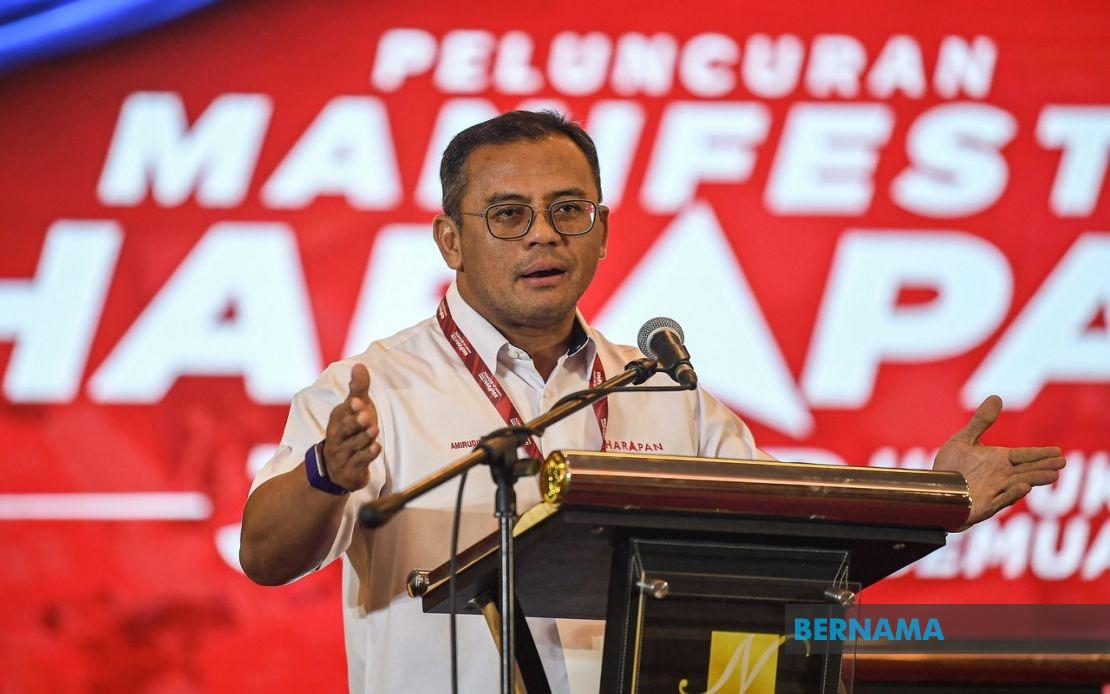
Pakatan Harapan is banking on its economic record to sway voters in the upcoming Johor state election, with senior coalition members presenting a vision centred on financial stability and growth under their stewardship. The push represents a deliberate strategy to frame the election around PH's performance since taking federal office, particularly the MADANI Government's management of Malaysia's macroeconomic environment during a period of global uncertainty. Speaking at the launch of PH's "Johor for All" manifesto in Johor Bahru on July 3, Datuk Seri Amirudin Shari, who serves as both Selangor Menteri Besar and a member of PH's Presidential Council, sought to draw voters' attention to the tangible outcomes of coalition governance across multiple levels of government.
The centrepiece of Amirudin's argument rests on currency performance and overall economic expansion. Under the administration of Prime Minister Datuk Seri Anwar Ibrahim, he noted, the ringgit has reached its strongest level in 16 years, a metric that typically signals investor confidence and economic stability. This achievement carries particular weight in Malaysia, where currency strength directly affects purchasing power, import costs, and the competitiveness of exports—concerns that touch the daily lives of ordinary citizens. The ringgit's appreciation, should it be sustained, could theoretically provide some insulation against inflation pressures that have affected households across Southeast Asia in recent years.
Beyond currency movements, Amirudin emphasised PH-controlled states' contribution to national prosperity. Penang and Selangor together account for nearly 40 per cent of Malaysia's total economic output, a concentration of wealth-generation that underscores the political and economic significance of these two jurisdictions. This dual-state dominance means that PH's performance in managing these major economies carries outsized implications for the federal government's overall credibility on economic matters. The coalition is acutely aware that electoral support often hinges on whether voters perceive their governments as competent stewards of public resources and drivers of opportunity.
Selangor's economic trajectory offers particularly striking comparative data. The state's economy was valued at RM432 billion according to Department of Statistics figures from the previous year, but the most recent assessment released just days before Amirudin's speech indicated expansion to RM460 billion—a gain of RM28 billion in a relatively short timeframe. This growth rate, if sustained, would represent a robust expansion trajectory. Notably, Amirudin highlighted that Selangor's economy now stands at approximately twice the size of Johor's, a comparison that carries obvious political weight in the context of campaigning in Johor. The implication, whether stated directly or left for voters to infer, is that PH-led economic management delivers superior results compared to rival administrations.
The timing of this economic messaging is strategically significant. The 16th Johor state election represents a critical test for PH's electoral viability, as Johor has historically been a political stronghold with substantial population and economic weight. By front-loading their campaign with economic credentials rather than other themes, PH is attempting to reset the frame around which the election will be contested. Instead of discussing governance philosophies, institutional reforms, or social policies, the coalition wants the conversation to centre on numbers: growth rates, currency strength, and comparative state performance. This approach assumes that voters will reward governments perceived as economically competent, regardless of other considerations.
Investment flows represent another element of PH's economic narrative. The coalition claims that high levels of foreign and domestic capital have been attracted under its governance, suggesting that the business community has confidence in the administration's direction. Investment inflows matter materially for employment creation, technology transfer, and long-term productivity gains. If this claim holds empirical scrutiny, it would indicate that investors see the PH-led government as a safer bet than potential alternatives, at least in terms of policy consistency and institutional stability. However, such claims warrant examination, as investment patterns respond to multiple factors including global conditions, sector-specific trends, and currency movements independent of any single government's policies.
GDP growth figures also feature prominently in the coalition's messaging. Consistent expansion in the nation's total economic output, as Amirudin claimed, would suggest that the MADANI Government has avoided major policy missteps that might trigger contraction or stagnation. This framing is particularly important given the economic headwinds that have buffeted the region, including inflation concerns, supply chain disruptions, and geopolitical uncertainties that have affected investment decisions and trade flows. If PH can credibly claim to have navigated these challenges while maintaining growth momentum, that becomes a powerful argument for continuity at the ballot box.
For Malaysian voters, particularly those in Johor, these economic arguments carry practical implications. Stronger economic performance typically correlates with job creation, higher wages, and improved public service delivery funded by stronger state revenues. Regional economic strength also benefits businesses and consumers through lower costs of goods and services, better infrastructure investment, and competitive economic opportunities. The Johor electorate, as a diverse population spanning urban centres, industrial zones, and agricultural regions, has varied economic interests that can be simultaneously affected by both state-level and federal policies. PH's strategy implicitly assumes that demonstrating competent economic management across both levels will resonate with this heterogeneous voter base.
The manifesto launch itself serves as a campaign instrument beyond the specific economic data presented. By choosing to emphasize economic performance at this particular moment, PH signals to voters and investors alike that it views economic governance as its strongest suit. This positioning may be calculated to deflect attention from other potential weaknesses or controversies while playing to perceived strengths. Whether this strategy proves effective will depend partly on whether rival coalitions can successfully challenge the economic narrative or redirect attention to other issues where they perceive advantages. The election outcome will ultimately reflect not just the accuracy of these economic claims but also how Malaysian voters weigh economic performance against other governance dimensions when making their electoral choices.

