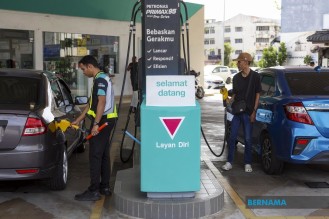
Malaysia's fuel supply situation has been declared stable and sufficient to sustain the country through August, according to Minister in the Prime Minister's Department (Law and Institutional Reform) Datuk Seri Azalina Othman Said. The assurance came during deliberations at the National Economic Action Council (MTEN) on June 25, following official correspondence from Petronas regarding inventory levels and distribution capacity across its extensive retail network.
Petronas Dagangan Bhd, the listed fuel retail arm of the national energy corporation, operates a distribution system that supplies approximately half of Malaysia's total domestic fuel requirements. This commanding market position makes Petronas's supply stability particularly significant for the country's economic continuity. The confirmation of supply adequacy through the summer months addresses immediate concerns raised by lawmakers questioning whether the oil major could sustain operations beyond June 2026 without fresh supply arrangements.
The government has responded to the complex geopolitical landscape by establishing a dedicated Crisis Management Task Force under MTEN. This entity operates as the coordinating mechanism through which various government departments, energy regulators, and commercial stakeholders collaborate to anticipate and mitigate potential disruptions. The task force's mandate extends beyond simple monitoring—it encompasses active procurement strategy, price management, and enforcement against irregular trading practices including fuel smuggling, which remains a persistent challenge in the region.
Datuk Seri Azalina elaborated that the task force maintains continuous surveillance of Malaysia's fuel, petroleum, and energy security posture, with particular attention to the months immediately ahead. Rather than relying solely on conventional supply routes, the government is actively exploring diversification strategies. Officials are in discussions with crude oil suppliers in West Africa and the Americas, seeking to establish new import relationships that would reduce dependency on Middle Eastern sources affected by the ongoing conflict in West Asia.
These procurement efforts operate within defined commercial parameters, as crude oil grades vary significantly in their suitability for Malaysian refining infrastructure. Not all sources can deliver crude types compatible with existing refinery specifications and environmental standards. The government is therefore carefully evaluating both the technical compatibility and commercial viability of alternative suppliers, ensuring that new arrangements do not compromise processing efficiency or economic competitiveness.
The framework being established reflects Malaysia's broader strategic energy positioning in an era of heightened global instability. The West Asia conflict has already disrupted shipping lanes and introduced uncertainty into traditional energy supply chains relied upon by Asian economies. By institutionalizing a dedicated task force, Malaysia signals its commitment to maintaining energy security as a non-negotiable priority, positioning the nation as economically resilient despite external shocks.
Price stabilization represents another critical element of the task force's mandate, indicating government concern that supply constraints could trigger inflationary pressures affecting consumers and businesses alike. Fuel prices influence transportation costs, manufacturing expenses, and ultimately the cost structure for goods and services across the economy. Maintaining reasonable pricing protects vulnerable segments of the population while preserving Malaysia's international competitiveness.
The minister's response addressed questions from Khairil Nizam Khirudin (PN–Jerantut), who had raised concerns about Petronas's earlier communication that supply guarantees extended only through June 2026. This apparent discrepancy—between a June 2026 deadline mentioned by Petronas and the government's August assurance—suggests ongoing negotiations between the corporation and government authorities regarding medium-term supply contracts and import agreements. The task force's visibility and activity may signal that more substantial arrangements are being finalized.
Smuggling prevention efforts highlighted by Datuk Seri Azalina underscore the reality that domestic fuel security cannot rely purely on supply flows—domestic market discipline matters equally. Illegal fuel movement across borders undermines both government revenue and supply predictability. Enhanced enforcement coordination between maritime authorities, customs, and police addresses this dimension of energy security that technical procurement alone cannot solve.
For Malaysian businesses and consumers, the assurance of stable fuel supplies through August provides operational confidence for planning purposes. However, the government's emphasis on task force establishment and alternative sourcing suggests that medium-term energy security depends on successful diversification away from West Asian sources. Companies and logistics operators should anticipate continued international crude oil volatility and factor in potential price fluctuations beyond the August horizon.
The government's approach represents pragmatic recognition that energy security in the modern era requires active state engagement across procurement, regulation, and enforcement. Rather than assuming stable global supplies, Malaysian authorities are building institutional capacity to navigate disruption. This positions the country better than neighbors lacking comparable coordination mechanisms, though sustained success depends on translating announced task force activity into tangible supply agreements over coming months.

