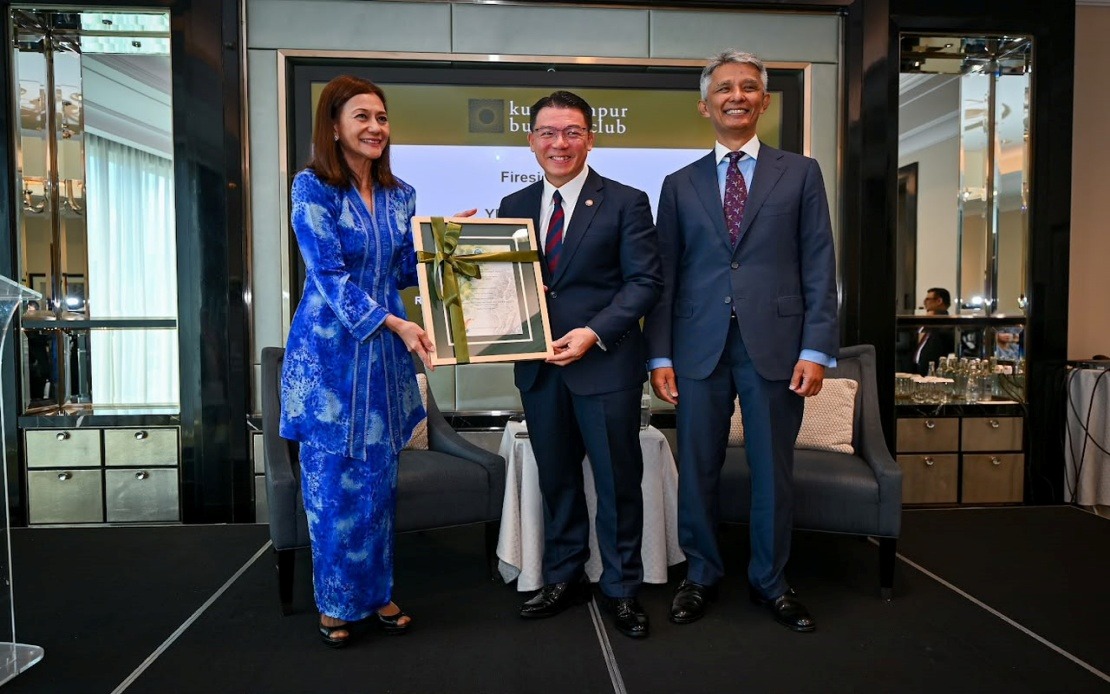
Malaysia's economic transformation hinges on unwavering commitment to policy continuity, Housing and Local Government Minister Nga Kor Ming stressed, arguing that sustained implementation of MADANI reforms remains the cornerstone for translating development initiatives into tangible economic benefits.
Speaking at a fireside chat organised by the Kuala Lumpur Business Club, Nga emphasised that governance consistency and a clear reform direction are not merely administrative preferences but strategic imperatives for maintaining the confidence of investors and securing Malaysia's competitive standing in an increasingly complex global economy. The minister elaborated that without steadfast adherence to established development frameworks, the gains achieved through earlier policy interventions risk unravelling, potentially undermining years of institutional and structural groundwork.
The session, themed "Future Cities, Future Growth: How MADANI Reforms Are Reshaping Malaysia's Urban Economy", convened business leaders and key stakeholders to examine how the government's transformation agenda is reshaping urban development and economic dynamics. Nga's remarks reflect a broader narrative within the current administration that emphasises the relationship between political stability, policy predictability, and economic performance—a connection that resonates particularly strongly across Southeast Asia's investor community, where political uncertainty frequently correlates with capital flight and reduced foreign direct investment.
Nga attributed Malaysia's recent improvements in investment attractiveness to deliberate efforts under Prime Minister Datuk Seri Anwar Ibrahim's leadership to deliver measurable progress across governance, economic stewardship, and international relations. He contended that the government's track record demonstrates that consistent reform implementation can yield concrete outcomes, citing enhanced investor confidence, improved economic resilience, and elevated Malaysia's standing in the global arena. These claims address a fundamental concern among Malaysian policymakers: how to differentiate the country from regional competitors and justify continued investor allocation in a crowded emerging markets landscape.
Among the specific achievements highlighted by the minister are Malaysia's emergence as a preferred investment destination, anchored by transparent policy frameworks, robust economic fundamentals, and the political stability necessary for long-term project planning. The minister also noted that Malaysia's trade performance has remained resilient despite persistent global economic headwinds, suggesting that the country's diversification efforts and supply chain integration are yielding defensive benefits during periods of external stress.
Improvement in Malaysia's Corruption Perceptions Index ranking represents another claimed success, with the minister presenting enhanced transparency as both a governance achievement and a practical tool for investor reassurance. Coupled with strengthened international credit ratings that reflect greater fiscal credibility, these metrics constitute the institutional foundation upon which investor decisions depend. International ratings agencies have become increasingly influential in determining the cost and availability of capital for developing economies, making Malaysia's improved standing particularly consequential for future infrastructure and growth financing.
Nga also referenced Malaysia's strategic partnerships with Turkmenistan and Russia as evidence that MADANI reforms have expanded diplomatic reach and opened new investment corridors. The RM52.73 billion strategic partnership with Turkmenistan and long-term energy collaboration initiatives with Russia exemplify how consistent foreign policy positioning can translate into substantive economic partnerships. For Malaysia, energy security and diversified partnership arrangements are strategically vital, given the country's energy-intensive manufacturing sector and its exposure to regional geopolitical realignments.
The minister's emphasis on a second-term mandate reflects calculations within the administration that continued governance authority would provide the necessary timeframe to deepen structural reforms, strengthen institutional capacity, and fully realise long-term economic transformation plans already in motion. This framing suggests that the government views Malaysia's transformation as a multi-term project requiring sustained implementation capacity and institutional memory. The argument carries implications for Malaysian voters contemplating the trade-offs between continuity and change, a perennial tension in democratic governance.
For Malaysia's business community and international investors, Nga's message offers both reassurance and a conditional promise: that political stability and policy consistency will continue to underpin the business environment. However, the minister's reliance on continuity arguments may also reflect underlying anxieties about whether current reform momentum can be sustained or whether the administration faces structural constraints that consistency alone cannot overcome. The emphasis on MADANI reforms as a coherent framework suggests the government views institutional and policy coherence as a competitive advantage in the region.
The broader context for these remarks involves Malaysia's position within Southeast Asia's competitive landscape, where countries including Indonesia, Vietnam, and Thailand are simultaneously pursuing infrastructure modernisation, digital transformation, and investment attraction. Malaysia's differentiation strategy appears to rest on institutional stability and governance quality rather than scale advantages. This positioning may prove effective for attracting quality foreign direct investment and retaining domestic capital, though it requires persistent demonstration of results and sustained commitment to announced reforms across multiple electoral cycles.

