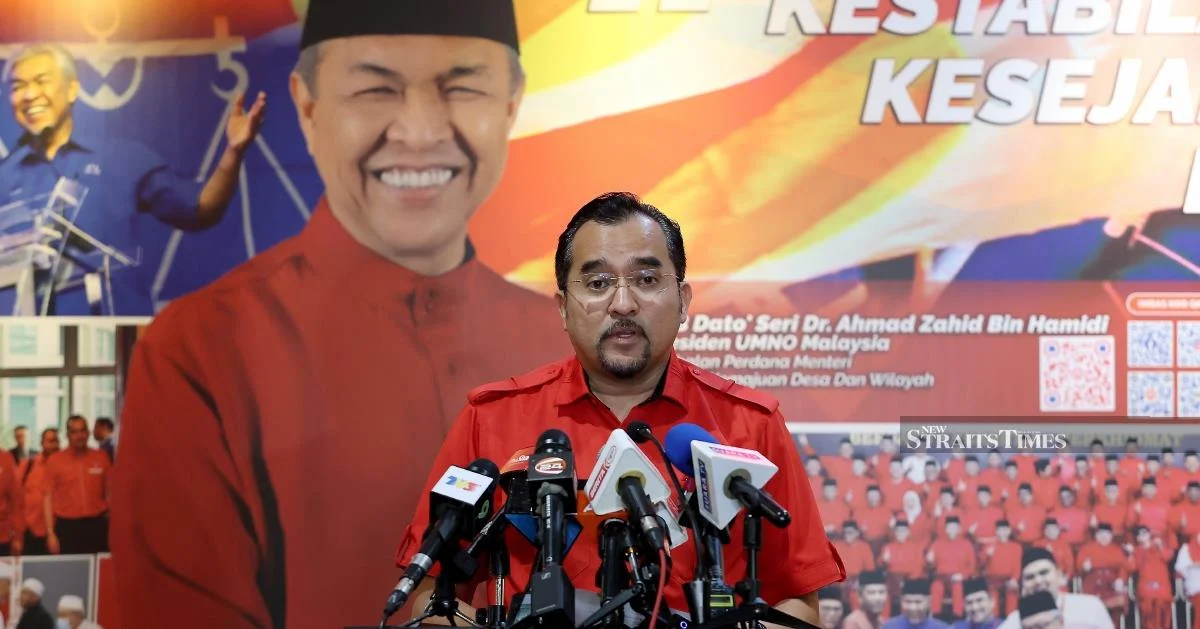
Umno intends to steer its electoral campaigns in Johor and Negri Sembilan towards substantive policy debates rather than personal attacks, according to the party's secretary-general Datuk Dr Asyraf Wajdi Dusuki. The undertaking signals an attempt by Malaysia's oldest political party to differentiate itself from rivals through principled advocacy, focusing on concrete solutions that resonate with voters facing economic pressures and inflation concerns.
The timing of Umno's commitment to a clean campaign reflects the broader political landscape facing Malaysian politicians. As state-level contests increasingly determine the composition of regional governments and shape legislative agendas, the tone and substance of electoral discourse influence public confidence in democratic institutions. By consciously rejecting mudslinging tactics, Umno appears intent on positioning itself as a serious governing party capable of elevating public discourse beyond personality-driven controversies.
For Johor, Malaysia's second-largest state by population and a traditional Umno stronghold, the party's focus on policy offers represents a strategic calculation. The state has long served as an economic engine for the nation, with a diverse base encompassing manufacturing, agriculture, and trade. Recent political volatility has unsettled investor confidence and administrative continuity. Umno's emphasis on practical governance proposals directly addresses voter anxiety about leadership stability and economic development.
Negri Sembilan, meanwhile, occupies a more competitive political space. The state's mixed demographics and swing-voting patterns make it susceptible to changes in electoral fortunes. The announcement that campaigns will centre on how party policies benefit ordinary citizens suggests Umno recognizes that messaging tailored to pocketbook issues—employment creation, cost-of-living relief, infrastructure investment—carries greater persuasive weight than attack narratives. This mirrors a broader global trend in mature democracies where policy-driven campaigns outperform personal-attack approaches in swaying undecided voters.
The secretary-general's public declaration serves multiple tactical purposes simultaneously. Internally, it reinforces party discipline by setting expectations that candidates and divisions must adhere to ethical campaign standards. Externally, it allows Umno to claim moral high ground should rival parties resort to negative campaigning, positioning the party as defending democratic norms. The statement also acknowledges public fatigue with divisive rhetoric; Malaysian voters have grown weary of scandals, court cases, and interpersonal disputes dominating political news cycles.
Implications for regional politics extend beyond state boundaries. As Southeast Asia's third-largest economy by GDP, Malaysia's domestic politics influence investor perceptions and regional stability. Demonstrations of mature political conduct—particularly among established parties with long histories—reinforce faith in institutional robustness. A Johor and Negri Sembilan campaign season characterized by policy substance rather than personal vitriol would contrast sharply with recent patterns and potentially raise expectations for electoral behaviour across the federation.
However, Umno's good intentions face practical tests. Rival parties may not reciprocate the commitment to clean campaigns, creating asymmetric competitive pressures. Candidate discipline, especially at grassroots levels, proves notoriously difficult to enforce when emotions run high. Additionally, determining where the line lies between legitimate policy criticism and personal attack remains subjective; what Umno considers a principled policy critique, opponents might characterize as mudslinging by another name.
The economic context amplifies the importance of Umno's policy-focused positioning. With inflation pressures, currency volatility, and global supply chain disruptions affecting Malaysian households, voters increasingly demand concrete solutions to tangible problems. Campaigns that address affordability, job creation, healthcare accessibility, and educational opportunities align more closely with voter priorities than personality-driven narratives. Datuk Dr Asyraf Wajdi Dusuki's emphasis on how party policies help people directly responds to this reorientation of voter concerns.
Umno's strategic choice also reflects institutional learning from recent elections. State-level contests offer laboratories for testing campaign approaches before federal-level contests. By deliberately adopting a policy-forward stance in Johor and Negri Sembilan, the party generates case studies regarding effective messaging strategies and can refine approaches based on electoral outcomes and public reception.
The commitment carries implications for coalition dynamics as well. If Umno successfully executes a dignified, issue-focused campaign, it potentially strengthens its bargaining position within Barisan Nasional and broader political alignments. Coalition partners and potential allies view consistent adherence to democratic norms as evidence of political maturity and reliability in governance partnerships. Conversely, abandoning the pledge would undermine Umno's credibility and weaken its negotiating leverage in future political arrangements.
Successfully maintaining campaign discipline in dual state contests demands coordination across party machinery, media relations protocols, and candidate vetting processes. Umno must ensure that party surrogates, social media accounts, and affiliated media outlets align with the official policy-focused approach. Inconsistencies or violations by subordinate party members or sympathetic commentators would fatally undermine the secretary-general's public commitment.
Ultimately, Datuk Dr Asyraf Wajdi Dusuki's declaration represents both a genuine attempt to elevate Malaysian political discourse and a calculated strategic move positioning Umno favourably in competitive state elections. Whether the party sustains this commitment throughout the campaign period will reveal much about contemporary Malaysian political culture and Umno's capacity for institutional discipline. For regional observers and investors monitoring Malaysia's political stability, the nature of Johor and Negri Sembilan campaigns will offer valuable indicators of whether Malaysian politics is trending towards more substance-driven engagement or reverting to established patterns of personal and partisan acrimony.